




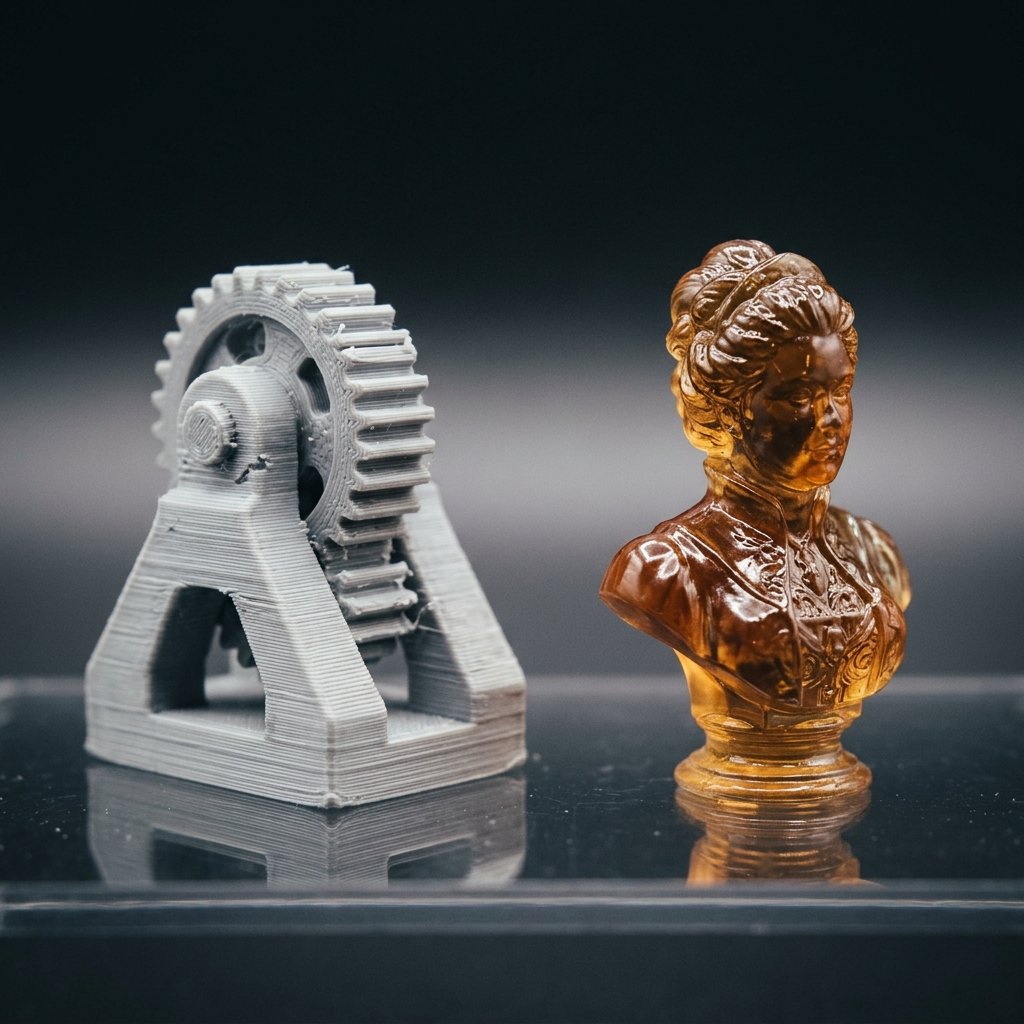
When starting out in 3D printing or commissioning a part, you will inevitably face a choice between two main technologies: **FDM (Fused Deposition Modeling)** and **SLA (Stereolithography)**. One uses spools of plastic filament, while the other uses liquid photopolymer resin cured by UV light. In this article, we compare their resolution, strength, workspace safety, and workflow so you can select the right technology for your application.
What is FDM (Fused Deposition Modeling)?
FDM is the most widely used 3D printing method. The printer melts plastic filament and extrudes it through a nozzle layer-by-layer on the build plate. It operates like a highly precise computer-controlled hot glue gun.
- Pros: Large build plates, inexpensive materials, wide choice of mechanical plastics (PLA, PETG, ABS, Nylon), low maintenance, safe for desktop use.
- Cons: Visible layer lines, poor precision on tiny details (under 1mm), prone to mechanical errors (warping, stringing).
What is SLA (Stereolithography) Resin Printing?
SLA uses a liquid photopolymer resin contained in a vat. An ultraviolet light source (laser or LCD screen) cures the resin layer-by-layer, transforming it from a liquid to solid plastic.
- Pros: Sub-micron detail resolution, completely smooth surfaces without visible layers, perfect for organic curves, microscopic accuracy.
- Cons: Toxic liquid resin releases fumes and requires PPE, messy wash-and-cure post-processing, fragile standard prints, smaller build plates.
💡 The Detail Factor
While an FDM printer typically prints layers at 0.15mm to 0.20mm height, SLA printers routinely print layers at 0.05mm down to 0.02mm. More importantly, FDM is limited in horizontal details by the width of the nozzle (typically 0.4mm), whereas SLA uses a light beam with a pixel size of just 20 to 50 micrometers.
Head-to-Head Comparison
1. Surface Finish & Resolution
If aesthetics, microscopic features, or smoothness are your priority, **SLA is the winner**. Prints look injection-molded, making layer lines virtually invisible. FDM prints will always have subtle horizontal ridges. While you can sand FDM prints, you cannot easily sand tiny, intricate geometries.
2. Structural Strength & Durability
For functional brackets, gears, or mechanical assemblies, **FDM is the winner**. You can print FDM parts in nylon, polycarbonate, or PETG, which withstand heavy impacts and high tensile stress. Most standard SLA resins are highly brittle and shatter like glass when dropped. While specialized "tough" engineering resins exist for SLA, they are expensive and still struggle to match the fatigue resistance of FDM thermoplastics.
3. Post-Processing & Workflow Cleanliness
FDM is a "dry" workflow: once the print finishes, you peel it off the bed, pull off the supports, and it's ready. SLA is a "wet" and messy workflow. You must wear nitrile gloves, wash the raw print in a bath of Isopropyl Alcohol (IPA) to dissolve uncured resin, and then cure the part under a UV lamp. Liquid resin is skin-sensitizing and hazardous to the environment, requiring proper chemical disposal.
Comparison Summary Table
| Feature | FDM (Filament) | SLA (Resin) |
|---|---|---|
| Detail & Resolution | Moderate (0.1mm - 0.4mm) | Exceptional (0.01mm - 0.05mm) |
| Mechanical Strength | High (Anisotropic but durable) | Low to Moderate (Typically brittle) |
| Post-Processing | Easy (Support removal) | Complex (IPA Wash, UV Cure, Safety PPE) |
| Build Volume Size | Large (typically 220mm³ - 500mm³+) | Small to Medium (typically 130mm - 200mm) |
| Best Application | Mechanical brackets, enclosures, prototypes | Miniatures, jewelry, dental, molds |
Conclusion: Which is Right for Your Project?
Choose FDM if you are building functional assemblies, housings, brackets, or anything that needs mechanical strength and low cost. Choose SLA if you are printing small figurines, tabletop miniatures, intricate jewelry master molds, or parts where a completely smooth finish is mandatory.
Not sure which technology fits your project? We specialize in high-quality FDM printing and can help you determine the best approach or advise on what fits your design. Visit our Contact Page to get a professional recommendation and quote!