




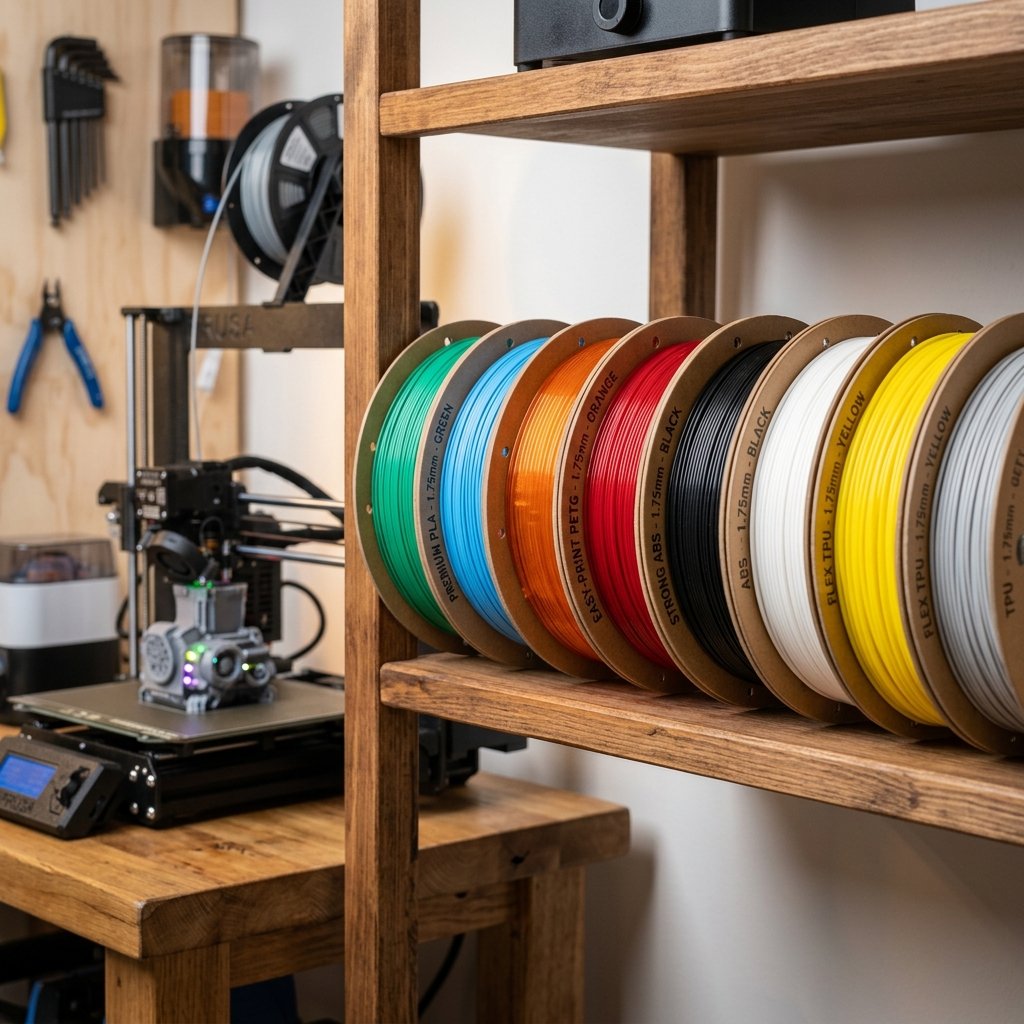
Choosing the right material is half the battle in 3D printing. The success of a project doesn't just depend on how nice the 3D model looks on screen, but on how the printed plastic behaves under stress, heat, and environmental factors. In this guide, we break down the four most common FDM filaments—PLA, PETG, ABS, and TPU—so you can make an informed choice for your next project.
1. PLA (Polylactic Acid) – The Beginner's Best Friend
PLA is the most popular filament in the 3D printing community. It is derived from organic, renewable resources like corn starch or sugarcane, making it more eco-friendly than petroleum-based plastics and pleasant to print with (it has a slightly sweet odor when heated).
- Ease of Printing: Extremely High. It prints at low temperatures (190°C - 220°C), doesn't require a heated print bed, and suffers from minimal thermal warping.
- Strength & Durability: Rigid and relatively strong under tension, but brittle. It can easily snap or shatter if subjected to sudden impacts.
- Heat Resistance: Low. PLA softens around 55°C - 60°C. Leaving a PLA print inside a hot car on a summer day will cause it to deform completely.
- Best Suited For: Decorative items, figurines, display prototypes, quick concept verification, and low-stress educational models.
2. PETG (Polyethylene Terephthalate Glycol) – The Practical Choice
PETG is basically the plastic used in water bottles, modified with glycol to make it easier to print and less brittle. It represents a middle ground between PLA's ease of use and ABS's structural strength.
- Ease of Printing: Moderate. It requires a heated bed (70°C - 85°C) and higher nozzle temperatures (230°C - 250°C). It is prone to "stringing" (hair-like plastic strands) if retraction and temperature settings aren't perfectly tuned.
- Strength & Durability: High impact resistance and good flexibility. It bends slightly before it breaks, making it highly durable for mechanical parts.
- Heat & UV Resistance: Good. It resists temperatures up to roughly 80°C and is evolutionarily superior to PLA outdoors, showing great resistance to sunlight and weather.
- Best Suited For: Mechanical brackets, outdoor fixtures, protective housings, and structural pieces that need functional strength.
💡 Tip: Wet Filament Ruins Prints
All 3D printing filaments, especially PETG and TPU, are hygroscopic—meaning they absorb moisture from the air. Wet filament causes popping sounds in the nozzle, bubbles in your print, and severe stringing. Keep your spools stored in airtight bags with desiccant packs, or dry them in a dedicated filament dryer before printing.
3. ABS (Acrylonitrile Butadiene Styrene) – Classic Strength
ABS has been a staple in engineering and industrial manufacturing for decades. It is the material used to make LEGO bricks. However, printing it on standard consumer machines can be a challenge.
- Ease of Printing: Difficult. ABS shrinks heavily as it cools down, leading to corner warping and layer cracking. To print ABS successfully, you need a high-temperature nozzle (240°C - 260°C), a heated bed (100°C - 110°C), and a closed printer enclosure to prevent drafts. It also releases strong, toxic fumes that require ventilation.
- Strength & Durability: Very tough, lightweight, and impact-resistant. ABS parts can be post-processed using acetone vapor to melt the surface slightly, sealing the layers and giving them a glossy, injection-molded look.
- Heat Resistance: High. It remains stable at temperatures up to 95°C - 100°C.
- Best Suited For: Automotive parts, electronic enclosures, tool handles, and components that will be exposed to high heat or friction.
4. TPU (Thermoplastic Polyurethane) – Elasticity and Toughness
TPU is a flexible elastomer that behaves like rubber. Unlike rigid plastics, TPU can be stretched, bent, and compressed, returning to its original shape afterward.
- Ease of Printing: Moderate to Hard. Because the filament is soft, it can get tangled or squeezed out of the side of extruder gears. It requires a direct-drive extruder (not Bowden setups) and must be printed very slowly (15mm/s - 30mm/s).
- Strength & Durability: Virtually indestructible. It has incredible layer adhesion, chemical resistance, and shock absorption properties.
- Heat Resistance: Moderate (up to 75°C - 80°C).
- Best Suited For: Phone cases, gaskets, dampening pads, custom tires for RC cars, belt drives, and flexible joints.
Comparison Matrix
| Material | Ease of Print | Flexibility | Impact Resistance | Max Operating Temp | Outdoor Usage |
|---|---|---|---|---|---|
| PLA | ⭐⭐⭐⭐⭐ | ⭐ | ⭐⭐ | ~50°C | Poor |
| PETG | ⭐⭐⭐ | ⭐⭐⭐ | ⭐⭐⭐⭐ | ~75°C | Excellent |
| ABS | ⭐ | ⭐⭐ | ⭐⭐⭐⭐⭐ | ~95°C | Moderate |
| TPU | ⭐⭐ | ⭐⭐⭐⭐⭐ | ⭐⭐⭐⭐⭐ | ~75°C | Good |
Conclusion
For 90% of your projects, PLA and PETG will do the job perfectly. Start with PLA for visual, low-impact designs, and switch to PETG when you need durability and outdoor survival. Save ABS for niche projects requiring high heat tolerance or chemical smoothing, and invest time in learning TPU when you need rubbery flexibility.
Need help selecting the best material or looking for professional 3D design and print services? Head over to our Contact Page to discuss your project requirements!