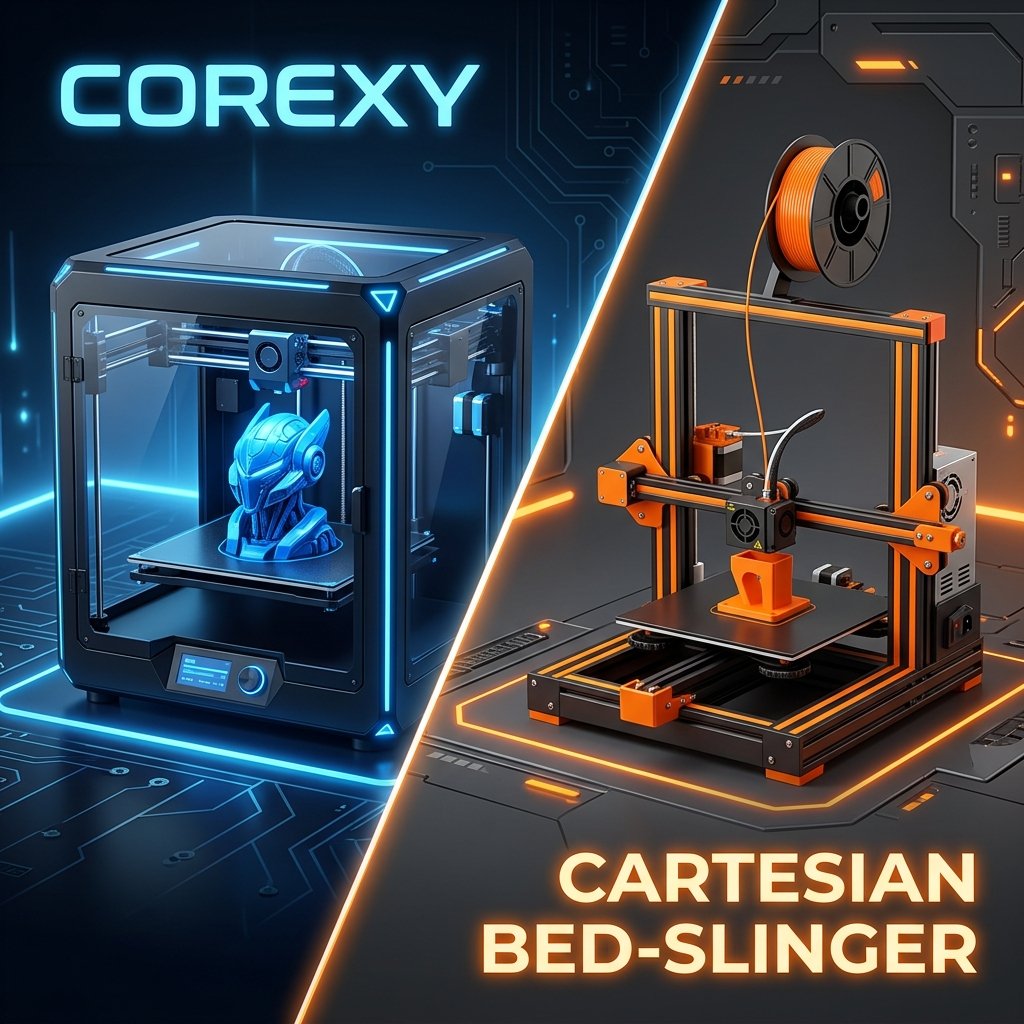
If you have been keeping an eye on the 3D printing landscape recently, you have likely noticed a major shift. The days of spending dozens of hours assembling a DIY printer kit, manual bed tramming with a piece of paper, and continuously tweaking eccentric nuts just to get a decent first layer are quickly fading away. In 2026, the market is heavily moving toward "appliance-style" machines. These are enclosed, pre-assembled, plug-and-play systems that print at lightning speeds with zero user tuning. At the heart of this revolution lies a transition from the traditional Cartesian "bed-slinger" kinematics to the highly stable "CoreXY" motion system. In this article, I will draw from my daily experience running a professional 3D printing service to break down exactly how these mechanical systems differ, why CoreXY has become the gold standard, and when a bed-slinger might still make sense for your workshop.
What is the Difference Between CoreXY and Bed-Slinger 3D Printers?
CoreXY 3D printers use a stationary bed on the Z-axis with belts moving the toolhead in X and Y, whereas bed-slingers move the bed along the Y-axis. CoreXY offers higher speeds, reduced vibration, and more stable print quality. This fundamental difference in movement mechanics shapes everything from the physical footprint of the machine to the maximum speed it can achieve without causing print defects.
To understand why this is such a game-changer, we have to look at the physics of motion in FDM 3D printing. In a traditional Cartesian bed-slinger (popularized by iconic printers like the original Prusa i3, Creality Ender-3, and Elegoo Neptune series), the motion is split across three independent axes. The print head moves left and right on the X-axis carriage, the entire X-axis gantry climbs up and down on the Z-axis lead screws, and the heavy build plate—along with the heated bed, glass or spring steel sheet, and the printed model itself—slides back and forth on the Y-axis. This means that as your model grows taller and heavier, the printer must sling more and more mass back and forth. This movement creates significant inertia, which inevitably leads to a physical phenomenon known as "ghosting" or "ringing"—visible wavy lines on the surface of your prints caused by microscopic frame vibrations.
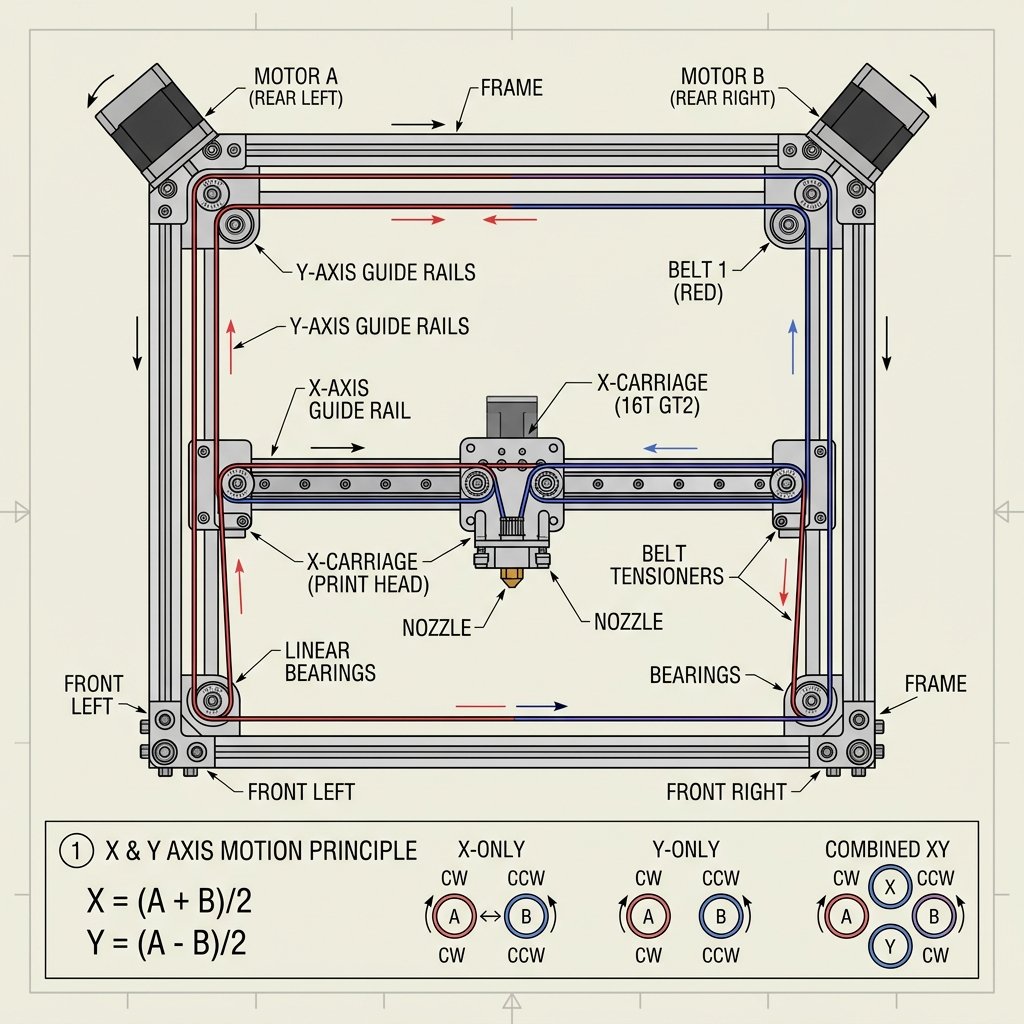
In contrast, a CoreXY motion system (found in modern machines like the Bambu Lab X1 Carbon, Creality K1C, and Voron builds) completely reimagines the gantry. The build plate only moves vertically along the Z-axis, stepping down fractionally as each layer is completed. The X and Y movements are handled entirely by a clever, interconnected system of two stationary stepper motors mounted at the back of the frame, driving two long belts in a continuous loop. These belts work in unison: when both motors turn in the same direction, the toolhead moves diagonally; when they rotate in opposite directions, it moves along a straight line. Because the motors are bolted securely to the rigid, outer frame rather than riding on the moving parts, the overall moving mass is extremely low. The toolhead carriage is light and agile, allowing the machine to accelerate, decelerate, and change directions almost instantaneously.
Key Advantages of CoreXY for High-Speed FDM Printing
The key advantages of CoreXY printers are their stationary print bed, lighter toolhead carriage, and rigid enclosed frame, which collectively enable printing speeds exceeding 500 mm/s without sacrificing print quality. These factors minimize inertia and vibrational resonance during high-acceleration moves, resulting in cleaner surface finishes. By eliminating the rapid back-and-forth movement of the build plate, CoreXY printers avoid the mechanical limitations that cap Cartesian printing speeds.
- Inertia Reduction and Vibration Control: In a bed-slinger, the mass of the print bed is a constant bottleneck. If you attempt to print at speeds over 150 mm/s on a bed-slinger, the rapid Y-axis directional changes will induce severe vibrations, resulting in poor layer alignment or even layer shifts. Since a CoreXY bed only moves vertically and at very slow increments, the weight of the printed object has zero impact on the X and Y motion systems. You can print a massive, heavy mechanical prototype just as fast as a tiny calibration cube without worrying about bed inertia.
- Rigid Cube Frame and Easy Enclosure: CoreXY printers are built inside a rigid, box-like cubic frame. This structural rigidity is essential for absorbing high-frequency vibrations during accelerations of 10,000 to 20,000 mm/s². Furthermore, the cubic shape makes it incredibly straightforward to enclose the machine. Having a fully enclosed printing chamber is vital for advanced engineering materials. If you work with filaments like ABS, ASA, or Polycarbonate, you need a warm, draft-free environment to prevent warping and ensure excellent layer adhesion. Enclosing a bed-slinger, on the other hand, is a hassle because the bed needs extra clearance to slide forward and backward, requiring a massive, bulky enclosure. For a detailed breakdown of different filaments and their thermal requirements, you can check our comprehensive 3D Printing Materials Guide.
- Reduced Physical Footprint: Because a bed-slinger's build plate must slide fully forward and backward, the printer requires a operating clearance depth that is often more than double the actual build plate length. A 300x300mm bed-slinger can easily take up over 700mm of desk depth. A CoreXY printer, however, keeps all X and Y movement self-contained within its physical outer frame. This means its operating footprint is virtually identical to its physical dimensions, saving valuable workspace in your lab or office.
- Superior Print Quality at Speed: With modern firmware utilizing Input Shaping (a software algorithm that measures and pre-compensates for the resonance frequencies of the printer frame), CoreXY gantries can achieve exceptionally clean surface details at speeds that would tear a traditional Cartesian printer apart. Details remain crisp, overhangs cool cleanly due to powerful stationary auxiliary fans, and vertical layers align with microscopic precision.
Maker's Workshop Note: In my years running a commercial print farm, switching our primary workhorses to enclosed CoreXY machines was the single best decision we ever made. Not only did our printing times cut down by 60% to 70%, but our rate of print failures dropped to nearly zero. The mechanical stability of a stationary bed is unmatched when printing high-tolerance mechanical brackets or tall, slender parts.
When Should You Choose a Bed-Slinger in 2026?
Bed-slingers remain an excellent choice in 2026 for budget-conscious hobbyists, large-format printing on a budget, and simple utility prints that do not require high speeds or advanced materials. Their simpler design makes them easier to maintain and cheaper to manufacture, which keeps their entry price point incredibly low. For users who prioritize affordability and straightforward mechanics, Cartesian printers still hold a vital spot in the market.
While the "appliance" era of CoreXY is dominating the high-performance and professional segments, bed-slingers are far from obsolete. In 2026, manufacturers have integrated many advanced features—such as Klipper-based high-speed firmware, linear rails, and automatic strain-gauge bed leveling—into Cartesian printers. Here is why you might still want to consider a bed-slinger:
- Incredible Cost Efficiency: If you are just starting out or need to scale up a farm for basic PLA prints, bed-slingers offer unbeatable value. You can easily purchase three or four modern, high-quality bed-slingers for the price of a single premium enclosed CoreXY printer. If raw throughput of basic parts is your goal and speed isn't a critical constraint, a fleet of low-cost Cartesian printers can be highly profitable.
- Mechanical Simplicity and Repairability: CoreXY belt paths are complex. If a belt breaks or needs to be retensioned, routing it through the multiple pulleys and ensuring both belts have identical tension can be a frustrating and time-consuming task for beginners. Bed-slingers, by contrast, are incredibly simple. Each axis has its own dedicated motor and belt. If you have an issue with the X-axis, you only inspect the X-axis. This makes them fantastic learning tools for students and hobbyists who want to understand the mechanical fundamentals of CNC machines. If you're designing custom parts and need advice on how to optimize them for FDM kinematics, explore our 3D Printing Design Tips Guide.
- Large Build Volumes: Scaling up a CoreXY printer to massive sizes (like 400x400x400mm or larger) requires a heavy, expensive frame and exceptionally long belts that are prone to stretching. In contrast, scaling a bed-slinger is mechanically straightforward. Large-format printers like the Elegoo Neptune 4 Max or Creality CR-M4 provide massive build volumes at a fraction of the cost of a large CoreXY system. They are ideal for printing large architectural models, props, or large functional parts where speed is secondary to size.
Top CoreXY FDM Printers to Consider
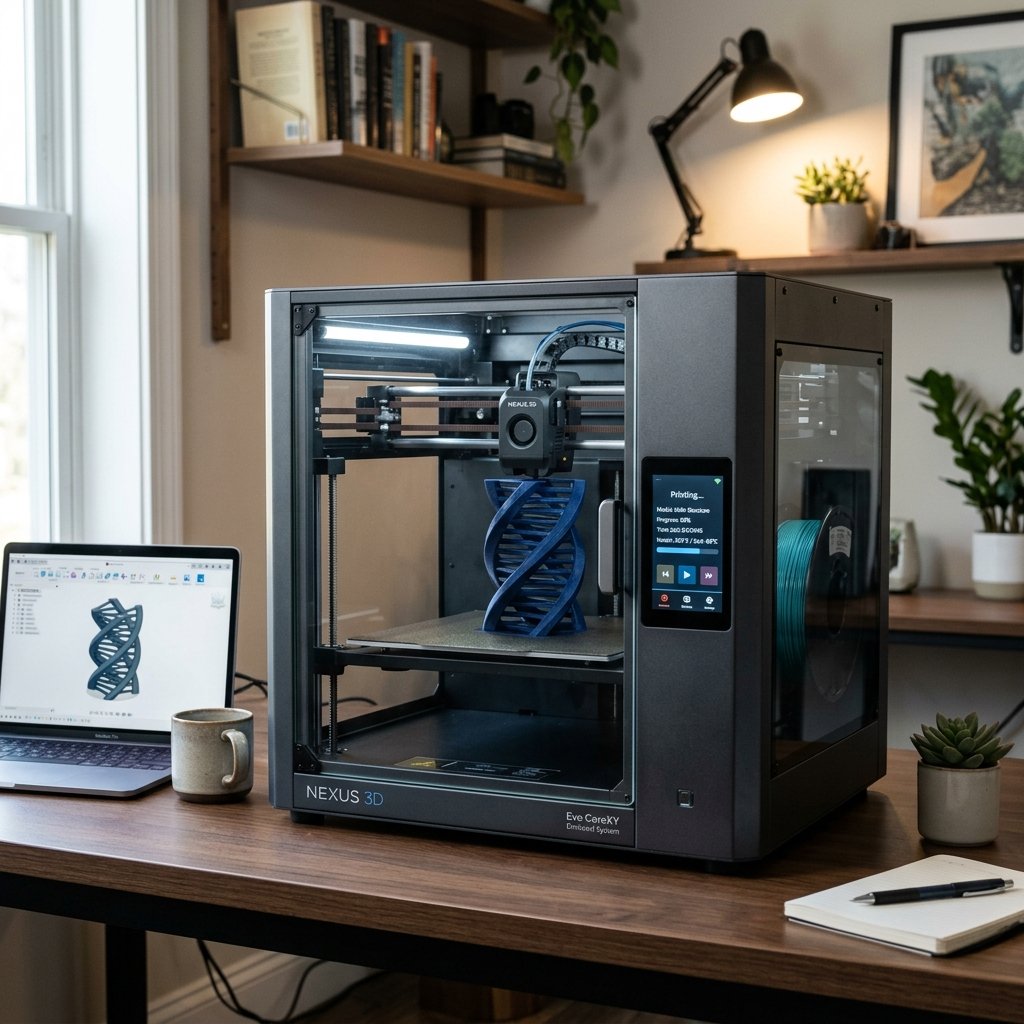
The best CoreXY FDM printers to consider in 2026 include the Bambu Lab X1-Carbon, Creality K1C, and Prusa XL, which offer plug-and-play multi-material printing, advanced lidar calibration, and robust build quality. These machines epitomize the appliance era of 3D printing, making high-quality results accessible with minimal setup. When looking for the best FDM 3D printer in 2026, these CoreXY models consistently lead the pack in speed, reliability, and ease of use.
Depending on your budget, experience level, and specific project requirements, several standout CoreXY models define the current market:
- Bambu Lab X1-Carbon / P1S: The machines that started the appliance revolution. They come fully enclosed, pre-calibrated, and feature advanced active vibration compensation. The X1-Carbon includes an Al-powered lidar sensor that automatically calibrates extrusion flow and inspects the first layer for defects. When combined with the Automatic Material System (AMS), these printers offer seamless, multi-color and multi-material printing with minimal waste. They represent the ultimate "it just works" experience.
- Creality K1C / K2 Plus: Creality's response to the high-speed market. The K1C is a compact, fully enclosed CoreXY printer featuring an all-metal extruder, a hardened steel nozzle, and active carbon air filtration, making it excellent for printing abrasive filaments like carbon-fiber-reinforced nylon out of the box. The newer K2 Plus introduces multi-color capabilities via the Creality Filament System (CFS), offering a larger build volume and competing directly with enterprise-level hardware.
- Prusa XL: A unique CoreXY design that uses a tool-changing system rather than a single-nozzle filament switcher. The Prusa XL can support up to five independent toolheads, allowing you to print with multiple materials (such as rigid PETG paired with flexible TPU, or soluble support structures) without the purge waste and slow swap speeds of single-nozzle multi-material systems. It is a highly robust, engineering-focused machine built for demanding professional applications.
- DIY Voron Series (Voron 2.4 / Trident): For the ultimate hobbyist who still wants the absolute best performance. Voron printers are open-source kits that you build completely from scratch. While they require a significant investment of time to assemble, tune, and configure, they use premium components and are highly customizable. A well-tuned Voron is one of the fastest, most reliable CoreXY machines in existence and is completely repairable with off-the-shelf parts.
Comparing Motion Systems: CoreXY vs. Bed-Slingers
To help you choose the right motion system for your specific needs, the following table summarizes the key differences between CoreXY and Cartesian bed-slinger architectures in 2026:
| Feature | CoreXY Motion System | Cartesian Bed-Slinger |
|---|---|---|
| Print Bed Motion | Z-axis only (moves up/down very slowly) | Y-axis only (moves back/forth rapidly) |
| Toolhead Speed | High to Extreme (300 - 600+ mm/s) | Moderate (100 - 250 mm/s) |
| Acceleration Limits | High (10,000 - 20,000+ mm/s²) | Low to Moderate (3,000 - 8,000 mm/s²) |
| Ease of Enclosure | Excellent (Cubic frame is easily sealed) | Difficult (Requires extra clearance for sliding bed) |
| Workspace Footprint | Compact (Equal to physical machine size) | Deep (Requires twice the bed length for clearance) |
| Mechanical Complexity | High (Interconnected belt paths, two motors) | Low (Independent motors per axis) |
| Aesthetic & Usability | "Appliance" style, plug-and-play, enclosed | "DIY" or open gantry style, often exposed |
| Typical Price Range | $400 - $1,500+ | $150 - $450 |
Frequently Asked Questions (FAQ)
Is CoreXY harder to maintain than a bed-slinger?
Yes, mechanically, CoreXY printers are more complex due to their long, intersecting belt paths and multiple pulleys. Ensuring equal tension on both belts is crucial for printing straight lines and perfect circles. However, because modern consumer CoreXY printers are sold as enclosed appliances, they generally require less frequent maintenance and tuning than open-frame bed-slingers, which are constantly exposed to dust and frame shifts.
Can a bed-slinger print as fast as a CoreXY printer?
A bed-slinger can match a CoreXY printer's speed on small, lightweight parts, but it cannot sustain those speeds on larger, heavier models. As the printed object grows, its physical weight increases the Y-axis inertia, leading to severe ringing, layer shifts, and print failures. CoreXY printers do not suffer from this limitation because the print bed only moves slowly on the Z-axis.
Why is the "appliance" model dominating FDM printing?
The appliance model is dominating because users want to focus on designing and using their printed parts rather than building, calibrating, and constantly troubleshooting their printers. Fully enclosed, pre-calibrated machines with smart features like lidar, auto-leveling, and filament runout sensors reduce print failures and save hours of frustration, making FDM printing as reliable as traditional paper printing.
Do I need an enclosure for CoreXY printing?
An enclosure is not strictly required for basic filaments like PLA and PETG, which print beautifully in open air. However, one of the biggest benefits of a CoreXY printer is that its cubic frame is easily enclosed. Having an enclosure allows you to print advanced materials like ABS, ASA, and Nylon by trapping heat and keeping ambient temperatures stable, which prevents warping and cracking.
About the Author: Dinu Suciu
Dinu Suciu is the founder of 3D Print Book, a premium 3D printing and prototyping service. Operating a fleet of high-speed FDM printers, Dinu has transitioned his workshop from traditional DIY Cartesian machines to fully enclosed CoreXY appliances. He writes guides and tutorials to share hands-on industry experience and help creators build higher-quality parts.
🛠️ Need Professional 3D Prints Without the Setup Hassles?
Whether you need engineering-grade parts in ABS, ASA, or Nylon, or simple prototypes in high-detail PLA, we have the machinery and expertise to deliver perfect results. Skip the learning curve, tuning hours, and costly failures of managing your own hardware. Let us handle it for you on our professionally calibrated industrial CoreXY systems.
Check out our 3D Printing Services or request an instant project quote on our Contact Page today!