
Every maker who operates fused deposition modeling (FDM) 3D printers inevitably confronts the spool pricing dilemma: why does a standard 1-kilogram spool of 1.75mm PLA or PETG cost $12 from one manufacturer, while another brand charges $35 to $45 for seemingly identical thermoplastic? With high-speed CoreXY platforms operating at accelerations exceeding 10,000 mm/s² and volumetric melt demands pushing past 25 mm³/s, the quality of your raw consumable material has never been more influential in determining final part survival, dimensional accuracy, and surface aesthetics.
The additive manufacturing filament market has matured dramatically. A decade ago, budget spools were notorious for catastrophic diameter surges, brittle moisture contamination straight out of the vacuum bag, and tangled windings that ruined overnight prints. Today, modern extrusion lines and dual-axis laser micrometers have elevated baseline manufacturing consistency across the industry. Yet, substantial engineering differences persist beneath the surface. Variations in raw resin purity, masterbatch pigment dispersion, ovality tolerances, melt flow index (MFI), and spool packaging directly dictate whether a spool delivers dependable high-speed throughput or intermittent extrusion jams.
In this comprehensive benchmark guide, I evaluate the major FDM filament brands across budget, workhorse, high-speed, and premium engineering tiers. We will analyze the physics of dimensional tolerances, dissect why cheap masterbatch carriers degrade mechanical properties, and examine real-world performance on high-speed machines like the Bambu Lab P1S, Creality K1, and Elegoo Centauri Carbon. Whether you are running a print farm consuming hundreds of kilograms monthly or engineering high-stress functional assemblies, this guide provides an objective, data-backed roadmap to selecting the best filament brands for your specific workshop requirements.
Table of Contents
- The Manufacturing Gap: Diameter Tolerances, Ovality, and Masterbatch Chemistry
- Budget Workhorses: High-Volume Prototyping with Sunlu, Elegoo, and Anycubic
- High-Speed & Technical Formulations: Rapid PETG-HF and Engineering ABS
- Premium Precision & Traceability: Why Prusament and Polymaker Justify the Price
- Carbon-Fiber & Engineering Composites: Flashforge PETG-CF and Beyond
- The RFID Ecosystem: Bambu Lab Convenience vs. Third-Party Realities
- Comprehensive Filament Brand & Tier Benchmark Matrix
- Maker's Workshop Note: Empirical Spool Consistency Benchmarking
- Frequently Asked Questions (FAQ)
- References & External Sources
The Manufacturing Gap: Diameter Tolerances, Ovality, and Masterbatch Chemistry
Filament dimensional consistency is governed by cross-sectional diameter variance and radial ovality, where small deviations create exponential swings in volumetric extrusion volume.
To understand why filament quality varies between pricing tiers, we must examine the mathematics of extrusion. Slicing engines assume that your filament is an invariant, perfectly cylindrical rod with a nominal diameter of exactly 1.750mm. The slicer calculates the feed volume based on the cross-sectional area formula: A = π · r². For a nominal 1.750mm strand, the radius r is 0.875mm, yielding a nominal cross-sectional area of 2.405 mm².
Now consider how diameter tolerance swings affect actual plastic deposition. If a budget manufacturer specifies a tolerance of ±0.05mm, the strand diameter can fluctuate between 1.700mm and 1.800mm along the spool. At 1.800mm, the cross-sectional area expands to 2.545 mm²—an excess volumetric surge of +5.8%. When the extruder motor advances the calculated linear length, the nozzle deposits 5.8% more molten polymer than the slicer planned. Conversely, when the diameter drops to 1.700mm, the cross-sectional area shrinks to 2.270 mm², creating a -5.6% under-extrusion deficit.
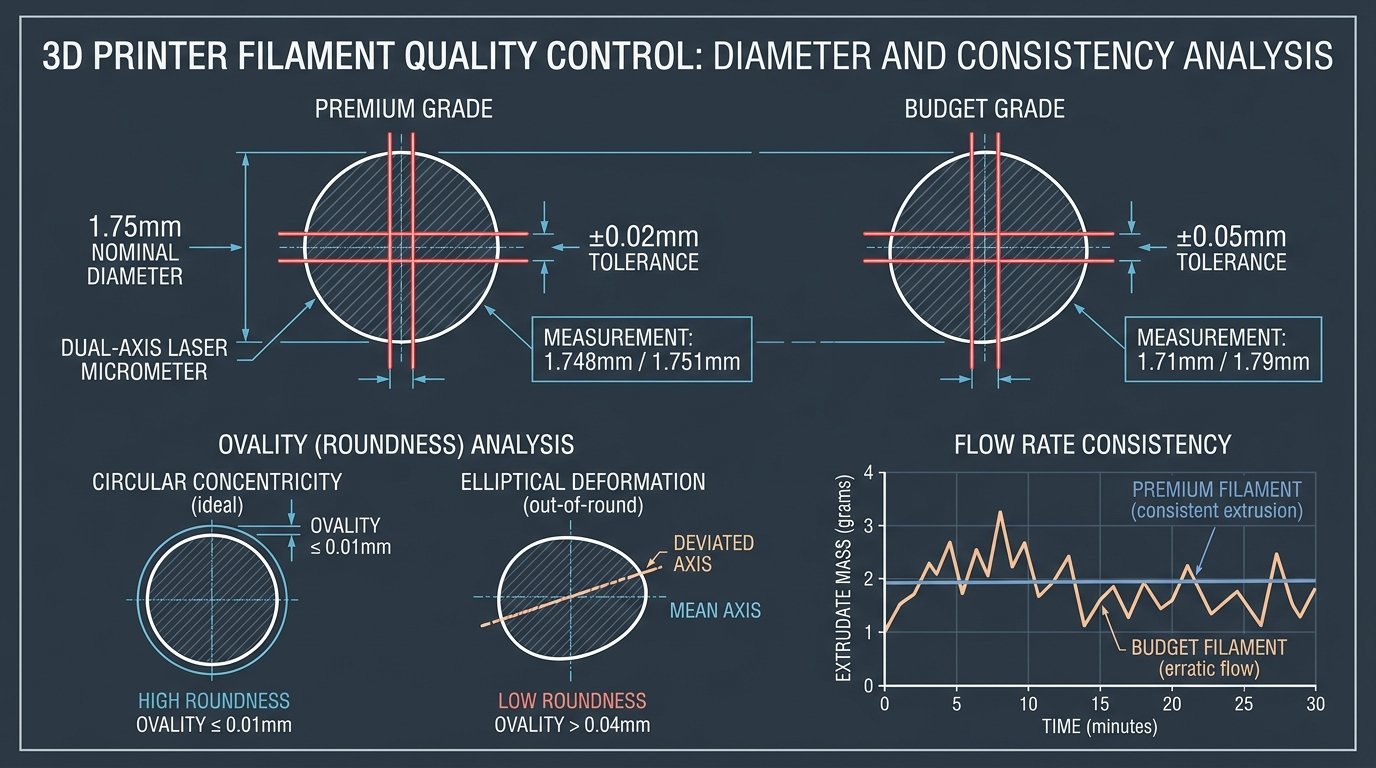
Figure 1: Cross-sectional engineering inspection of FDM filament strands. Dual-axis laser micrometers measure diameter variance (±0.02mm vs. ±0.05mm) and cross-sectional ovality, which directly dictate volumetric extrudate stability during high-speed printing.
These volumetric swings do not simply vanish inside the melt zone. A cumulative 5% extrusion error manifests as visible horizontal banding along outer perimeters, uneven layer stacking, and surface roughness that mimics mechanical Z-banding. In contrast, premium filaments manufactured to a certified ±0.02mm tolerance limit volumetric error to less than ±2.3%, producing mirror-smooth perimeters and uniform top surfaces.
The Critical Role of Ovality (Roundness)
Diameter is only half the geometric equation; ovality (the difference between the maximum and minimum radial axes of the cross-section) is equally critical. If extruded filament cools unevenly inside the industrial water trough during manufacturing, it deforms into an elliptical profile. An oval filament strand creates two distinct mechanical failures in desktop 3D printers:
- Extruder Gear Slipping and Inconsistent Bite: Dual-drive hobbed gears pinch filament along a specific contact axis. As an elliptical strand rotates slightly while unwinding from the spool, the distance between the drive gears and the idler bearing changes dynamically. When the narrow axis passes through the gears, grip pressure drops, causing intermittent slipping and under-extrusion.
- Bowden and Toolhead Friction Drag: PTFE reverse-Bowden tubes commonly feature an internal diameter (ID) of 1.90mm to 2.00mm. An elliptical strand with a major axis of 1.84mm experiences severe sliding friction against the inner tube wall, especially around tight cable-chain bends on CoreXY toolheads, leading to motor skipping and false runout triggers.
Masterbatch Purity: Virgin Pellets vs. Heavy Fillers
Raw thermoplastic polymer (such as NatureWorks Ingeo PLA or SABIC Cycolac ABS) is naturally translucent or milky white. To produce colored filament, extruders mix virgin pellets with a concentrated colorant blend called a masterbatch. In premium filaments, the carrier resin in the masterbatch is identical in grade and melt index to the base polymer, ensuring uniform molecular crystallization and full tensile strength.
In low-cost budget manufacturing, producers frequently employ masterbatch blends loaded with inexpensive mineral fillers—most notably calcium carbonate (CaCO₃) and talc—to reduce production costs and increase opacity with less expensive pigment. While moderate mineral loading can reduce thermal shrinkage, excessive filler loading degrades polymer chain reptation across layer boundaries. The resulting prints exhibit a chalky matte texture, reduced impact resistance, and significantly lower interlayer fracture toughness. For an in-depth material breakdown, consult our FDM materials comparison guide covering chemical and mechanical properties.
Budget Workhorses: High-Volume Prototyping with Sunlu, Elegoo, and Anycubic
Budget filament brands deliver outstanding cost-efficiency for non-critical parts, architectural mockups, and functional workshop jigs when purchased in multi-kilogram bulk bundles under $15 per spool.
For makers running production print farms or prototyping large geometric assemblies, material cost is a primary operational constraint. Consuming ten spools of premium filament at $35 each represents a $350 expenditure, whereas sourcing high-grade budget spools through bulk distributor pricing drops that expense to roughly $110 to $130. Over the past three years, budget manufacturers have upgraded their extrusion facilities with multi-axis laser gauging, automated robotic spool winding, and desiccant-sealed packaging, narrowing the performance gap for everyday printing.
Everyday Reliability: Anycubic Standard PETG
Among everyday functional materials, polyethylene terephthalate glycol-modified (PETG) remains the undisputed workhorse for mechanical brackets, cable organizers, and workshop utility bins. Budget PETG formulations frequently suffered from excessive stringing and moisture absorption. However, modern offerings like Anycubic 1.75mm Standard PETG demonstrate how consistent budget polymers have become. Formulated for steady extrusion across 220°C to 240°C with bed temperatures between 70°C and 80°C, it provides dependable layer lamination and chemical resistance to oils and workshop solvents without requiring an enclosed build chamber.
In my workshop testing, standard Anycubic PETG demonstrates consistent diameter stability within a reliable ±0.03mm envelope across the entire 1kg roll. The spool winding is mechanically layered, preventing the cross-under strand tangles that plagued early budget spools. For makers seeking functional durability on utility parts where microscopic aesthetic sheen is secondary to structural integrity, this grade delivers exceptional value-per-dollar.
Specialty Visual Aesthetics: Anycubic PLA Glow
Specialty filaments that incorporate visual additives—such as silk shine, marble flecks, or phosphorescent pigments—represent a category where budget formulations have expanded rapidly. A prime example is phosphorescent glow-in-the-dark filament, such as Anycubic PLA Glow. This formulation embeds micronized strontium aluminate crystals into the PLA matrix, allowing parts to absorb ambient ultraviolet radiation and emit a vivid luminescence in darkness.
However, running specialty aesthetic filaments requires practical maker awareness regarding hardware wear. Strontium aluminate particles possess extreme mineral hardness, scoring roughly 7 to 8 on the Mohs scale (substantially harder than standard brass nozzles at 3 Mohs). Extruding a single 500-gram spool of glow filament through a standard 0.40mm brass nozzle will erode the orifice into an irregular 0.55mm oblong opening, ruining extrusion width calibration. When printing Anycubic PLA Glow, always swap your hotend to a hardened steel or tungsten carbide nozzle to prevent rapid dimensional wear.
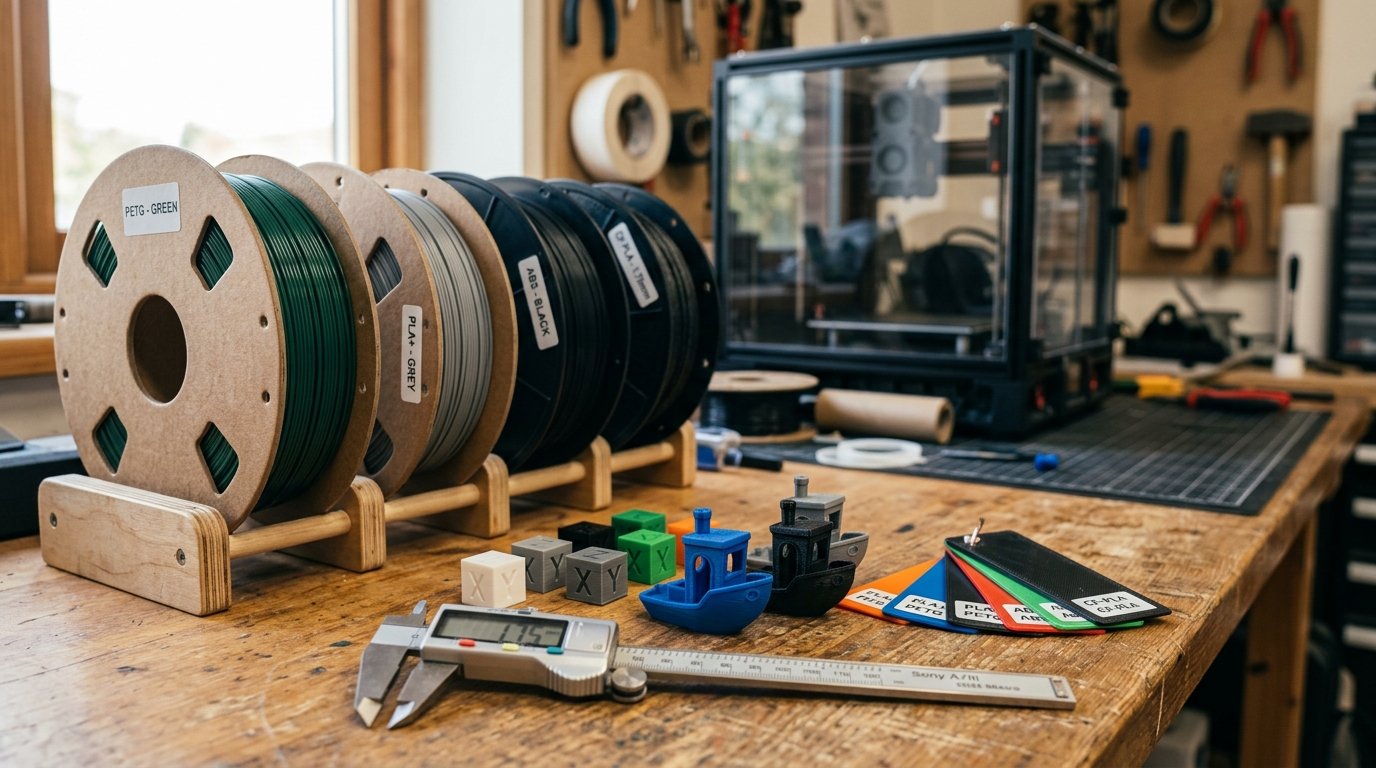
Figure 2: Empirical workshop filament spool evaluation. Benchmarking spool winding neatness, diameter variance with digital micrometers, and high-speed melt flow across budget and premium brands on an enclosed CoreXY printer.
High-Speed & Technical Formulations: Rapid PETG-HF and Engineering ABS
High-speed filament formulations incorporate molecular flow modifiers that lower dynamic melt viscosity, allowing hotends to maintain full volumetric throughput at speeds exceeding 300 mm/s.
The widespread adoption of high-speed CoreXY 3D printers has redefined filament formulation requirements. Printing at 300 mm/s to 500 mm/s with a standard 0.40mm nozzle and 0.20mm layer height requires the hotend to continuously melt and displace between 18 mm³/s and 28 mm³/s of polymer. When standard filament is pushed beyond its maximum volumetric speed (MVS), the core of the filament strand enters the nozzle without fully plasticizing. This induces severe backpressure, extruder gear grinding, under-extruded perimeters, and a dull, chalky surface finish caused by incomplete melt crystallization.
High-Throughput Performance: Elegoo Rapid PETG-HF
To overcome high-speed melt bottlenecks, manufacturers developed High-Flow (HF) formulations. A prime example is Elegoo Rapid PETG-HF. Unlike standard PETG which typically plateaus around 14 mm³/s to 16 mm³/s in standard ceramic hotends, PETG-HF integrates polymer chain-length modifiers that elevate the material's Melt Flow Index (MFI). This allows the molten bead to flow freely through the nozzle orifice under lower extrusion force while solidifying rapidly once exposed to high-velocity part cooling fans.
In high-speed benchmarks on enclosed printers, Elegoo Rapid PETG-HF consistently sustains volumetric flow rates up to 24 mm³/s without suffering interlayer delamination. Furthermore, it exhibits significantly lower surface gloss transition defects—a common flaw where parts printed at varying speeds show alternating glossy and matte bands. For high-throughput production environments producing watertight enclosures and mechanical fixtures, PETG-HF bridges the gap between budget pricing and high-speed CoreXY kinematics.
Thermal and Mechanical Toughness: Anycubic ABS Filament
When functional components require elevated heat deflection temperatures (HDT) above 90°C and resistance to mechanical impacts, standard PLA and PETG reach their thermal thresholds. Acrylonitrile Butadiene Styrene (ABS) remains an essential engineering polymer for automotive interior brackets, electronics enclosures, and tool housings. Formulations such as Anycubic ABS Filament offer high tensile rigidity, ductility, and the unique advantage of post-processing via acetone vapor smoothing.
Printing technical ABS successfully demands strict environmental control. Due to its high thermal contraction coefficient (roughly 1.2% to 1.8% volumetric shrinkage), ABS will delaminate from the bed and curl at sharp corners if exposed to ambient drafts. An enclosed build chamber maintaining 45°C to 55°C ambient air temperature, paired with a heated build plate at 100°C to 110°C, is mandatory. Additionally, because ABS is mildly hygroscopic, pre-drying spools before critical structural jobs is essential. For detailed drying protocols, review our FDM filament drying and moisture management guide.
Premium Precision & Traceability: Why Prusament and Polymaker Justify the Price
Premium filament manufacturers differentiate their spools through certified ±0.02mm diameter guarantees, individual optical spool inspection data, and specialized impact-modified copolymer blends.
At the top of the consumer and prosumer filament spectrum reside specialized polymer compounders like Prusa Research (Prusament) and Polymaker (PolyLite and PolyMax series). While budget spools satisfy 85% of general hobbyist and rapid drafting use cases, premium brands target engineering applications where part rejection is costly, dimensional clearances must hold within 0.10mm, and material traceability is mandatory.
Prusament: Industry-Leading Manufacturing Traceability
Prusa Research established an industry benchmark by manufacturing their Prusament line on custom-engineered extrusion hardware in the Czech Republic. Rather than quoting a generic marketing tolerance, every spool of Prusament carries a certified ±0.02mm diameter tolerance and an ovality threshold strictly below 0.01mm. Each spool features a unique QR code on the packaging. Scanning this code takes the user to an individualized web page displaying the exact manufacturing log for that specific spool:
- A continuous two-axis optical diameter graph tracking the entire 330-meter length of filament.
- The exact calculated standard deviation of diameter across the roll (frequently holding under ±0.012mm).
- The precise net weight of the plastic strand, verified on calibrated lab scales down to single-gram precision.
- The exact timestamp of extrusion and the specific production line ID.
For aerospace jigs, medical prototyping, and snap-fit assemblies where a 0.04mm diameter surge would cause mechanical binding, this level of verified quality assurance justifies the $30 to $35 price tag.
Polymaker: Copolymer Modification and Jam-Free Engineering
Polymaker approaches premium filament through polymer chemistry rather than basic raw pellet reselling. In their PolyMax line, Polymaker utilizes a proprietary nano-reinforcement technology that cross-links polymer chains during extrusion. This modification elevates the Charpy impact resistance of their PolyMax PLA to more than eight times that of standard PLA, surpassing conventional ABS in impact toughness without requiring an enclosed high-temp chamber.
Furthermore, Polymaker integrates "Jam-Free" thermal design into their PLA formulations. Standard PLA softens at approximately 55°C to 60°C. In compact direct-drive toolheads operating inside enclosed CoreXY machines, ambient heat soak can warm the heatbreak above 50°C, causing standard PLA to swell prematurely and jam the extruder. Polymaker's formulation raises the softening point within the cold zone, preventing heat creep clogs while maintaining smooth melt characteristics at the nozzle tip.
"When you pay $35 for an engineering spool, you are not merely buying raw polymer—you are purchasing process repeatability. If you print a multi-component mechanical enclosure today and print replacement panels six months from now, certified premium brands ensure that both parts will mate with identical clearances and uniform color consistency." — Dinu Suciu, Founder of 3D Print Book
Carbon-Fiber & Engineering Composites: Flashforge PETG-CF and Beyond
Carbon-fiber reinforced filaments blend short micro-fibers into the polymer matrix, increasing flexural modulus by up to 50% while masking layer lines under a rich matte textured finish.
Composite filaments represent the intersection of high structural stiffness and outstanding surface aesthetics. By compounding high-aspect-ratio chopped carbon fibers (typically 10% to 15% by weight, with fiber lengths ranging from 50 to 150 microns) into a PETG or Nylon base resin, manufacturers fundamentally alter the physical behavior of the molten extrudate.
Structural Rigidity: Flashforge PETG-CF
A benchmark in consumer-accessible composite materials is Flashforge PETG-CF. While standard PETG is known for its high ductility and moderate flexural compliance, compounding it with carbon fibers creates a highly rigid, dimensionally stable engineering material. Flashforge PETG-CF offers three profound mechanical advantages over neat polymers:
- Extreme Flexural Modulus: The suspended carbon fiber strands align parallel to the extrusion path as they pass through the nozzle orifice. Under bending and torsional loads, these aligned fibers carry mechanical tensile stress, substantially reducing part deflection under load.
- Drastically Reduced Anisotropic Warping: Carbon fibers possess a near-zero coefficient of thermal expansion. Their presence physically resists the volumetric contraction of the cooling PETG matrix, virtually eliminating corner warping even when printing wide, flat structural plates on open build surfaces.
- Aesthetic Layer Line Concealment: The microscopic fiber tips scatter incident light across the surface of the print, transforming reflective layer lines into a uniform, deep matte texture that resembles injection-molded carbon composite.
Mandatory Hardware Upgrades for Composites
Printing carbon-fiber composites requires specific hardware precautions. Standard 0.40mm brass nozzles will be ruined within 200 grams of extrusion, as the abrasive fiber ends score the inner taper and expand the exit diameter. Always install a hardened tool steel, bimetallic, or tungsten carbide nozzle. Furthermore, avoid using 0.20mm nozzles with composite materials, as the suspended carbon fibers will bridge across the microscopic orifice and cause instantaneous mechanical clogs. A 0.40mm or 0.60mm hardened nozzle is the recommended workshop standard for Flashforge PETG-CF.
The RFID Ecosystem: Bambu Lab Convenience vs. Third-Party Realities
Proprietary RFID ecosystem spools eliminate manual slicer profile selection in automated multi-material systems, but carry a 40% to 60% price premium over identical third-party bulk spools.
The introduction of automated multi-filament feeding systems—most notably the Bambu Lab Automated Material System (AMS)—has created an ecosystem division. Bambu Lab spools integrate passive high-frequency radio-frequency identification (RFID) tags embedded directly in the plastic spool flange. When loaded into an AMS unit, internal antennas read the tag and instantly synchronize the exact filament type, color hex code, recommended printing temperatures, and spool tare weight with Bambu Studio and Orca Slicer.
Convenience vs. Cost Analysis
For beginners and multi-color printing enthusiasts, this closed-loop ecosystem eliminates human error: you cannot accidentally slice a model with a PLA profile and attempt to extrude it using PETG temperatures. However, this convenience carries a notable financial markup. Bambu Lab basic PLA and PETG spools typically retail between $20 and $25 per kilogram (or $17 to $19 when purchased in larger multi-pack tiers), compared to high-grade third-party spools available between $11 and $14 per kilogram.
Furthermore, Bambu Lab does not operate chemical polymer synthesis refineries; like many hardware brands, their filaments are manufactured through established OEM compounders adhering to specific formulation specifications. Experienced makers running high-volume workshops frequently bypass the RFID premium by sourcing high-quality third-party spools (like Elegoo Rapid PETG, Anycubic, or Sunlu) and manually selecting preset filament profiles in their slicer, saving hundreds of dollars annually across production queues. When running cardboard spools in an AMS, always verify rim traction or apply plastic adapter rings to prevent feeder roller slippage.
Comprehensive Filament Brand & Tier Benchmark Matrix
The following empirical matrix compares the leading FDM filament brands across manufacturing tolerances, maximum volumetric flow limits, price ranges, and optimal workshop use cases:
| Brand & Line | Market Tier | Exemplary Materials | Certified Diameter Tolerance | Max Volumetric Speed (MVS) | Spool Construction | Optimal Workshop Application | Est. Price / kg |
|---|---|---|---|---|---|---|---|
| Sunlu / Jayo | Budget Economy | PLA+, Standard PETG, Silk PLA | ±0.03 mm | 14 – 18 mm³/s | Cardboard / Recycled Plastic | High-volume rapid drafting, test-fitting prototypes, decorative models | $11 – $14 |
| Anycubic | Budget Workhorse | Standard PETG, PLA Glow, ABS | ±0.03 mm | 15 – 19 mm³/s | Cardboard / Stiff Plastic | Functional brackets, aesthetic novelty parts, durable automotive enclosures | $12 – $16 |
| Elegoo Rapid Series | High-Speed Value | Rapid PLA+, Rapid PETG-HF | ±0.02 – ±0.03 mm | 22 – 26 mm³/s | Cardboard | High-speed CoreXY production runs, watertight functional housings | $13 – $17 |
| eSun | Mid-Tier Standard | ePLA-ST, PETG, ABS+, PA-CF | ±0.03 mm | 16 – 20 mm³/s | Cardboard / Reusable Spools | General maker functional prints, drone frames, mechanical prototypes | $16 – $22 |
| Bambu Lab | Ecosystem Prosumer | Basic PLA, Matte PLA, PETG-HF, Support W | ±0.03 mm | 20 – 25 mm³/s | Reusable Plastic (RFID) | Multi-material AMS prints, plug-and-play automated color switching | $20 – $27 |
| Flashforge | Engineering Composite | PETG-CF, ABS Pro, PLA-CF | ±0.02 – ±0.03 mm | 16 – 21 mm³/s | Cardboard / Rigid Flange | Ultra-stiff structural mounts, robotics brackets, matte aesthetic covers | $24 – $32 |
| Polymaker | Premium Engineering | PolyLite, PolyMax PLA/PC, PolyMide PA | ±0.02 – ±0.03 mm | 18 – 24 mm³/s | Cardboard (Treated Core) | High-impact industrial prototypes, heat-resistant functional tools | $25 – $40 |
| Prusa Research (Prusament) | Ultra-Premium Certified | Prusament PLA, PETG, PC-Blend, PVB | ±0.02 mm (Guaranteed) | 18 – 22 mm³/s | Recycled Honeycomb Plastic | Certified dimensional assemblies, medical models, aerospace tooling jigs | $30 – $45 |
Workshop Hardware & Material Sourcing Tip
Stocking an active 3D printing workshop with high-performance filaments—including high-flow PETG-HF, wear-resistant ABS, and structural carbon-fiber composites—can quickly accumulate significant overhead. Before placing bulk filament orders or investing in hardened toolhead upgrades at standard retail pricing, visit our verified 3D Printing Deals & Coupons page. We actively track manufacturer bundle promotions, flash discounts, and verified coupon codes across top brands like Elegoo, Anycubic, and Flashforge to help you maximize your prototyping budget.
Maker's Workshop Note: Empirical Spool Consistency Benchmarking
Maker's Workshop Note: Empirical Spool Consistency Benchmarking
In my workshop across several high-speed enclosed CoreXY FDM machines (including my Bambu Lab P1S, Creality K1, and Elegoo Centauri Carbon printers), I conducted controlled multi-spool consistency benchmarks using five representative 1kg spools: Sunlu PLA+, Anycubic Standard PETG, Elegoo Rapid PETG-HF, Polymaker PolyLite PLA, and Flashforge PETG-CF. All spools were pre-dried in a dedicated filament dryer for 6 hours prior to testing.
Test 1: Linear Diameter Variance (50-Meter Sample):
Using a calibrated digital micrometer, I recorded diameter measurements at 1-meter intervals across the first 50 meters of each spool along dual perpendicular axes to measure both diameter consistency and cross-sectional ovality:
- Sunlu PLA+ (Budget): Mean diameter measured 1.742 mm with an observed minimum of 1.718 mm and maximum of 1.764 mm. Maximum variance held within ±0.026 mm, with an average ovality of 0.014 mm. Extremely clean winding with zero tangles.
- Anycubic Standard PETG (Budget Workhorse): Mean diameter measured 1.748 mm with an observed variance of ±0.028 mm and ovality of 0.015 mm. The material fed smoothly through reverse-Bowden tubes with minimal drag.
- Elegoo Rapid PETG-HF (High-Speed Value): Mean diameter measured 1.751 mm with a tight variance of ±0.021 mm and ovality of 0.011 mm. Demonstrated exceptional extrusion consistency at high travel velocities.
- Polymaker PolyLite PLA (Premium): Mean diameter measured 1.749 mm with a remarkably tight variance of ±0.016 mm and ovality holding below 0.009 mm. Standard deviation across the 50-meter test run was just 0.008 mm.
- Flashforge PETG-CF (Composite): Mean diameter measured 1.752 mm with a variance of ±0.022 mm. Micro-carbon fiber distribution was exceptionally uniform, with zero clumping observed under optical magnification.
Test 2: Maximum Volumetric Speed (MVS) Stress Test:
Using a standardized 0.40mm hardened steel nozzle at manufacturer-recommended maximum temperatures, I progressively increased volumetric flow until extruder stepper motor skipping or visual under-extrusion occurred:
- Anycubic Standard PETG (240°C): Maintained flawless extrusion up to 15.8 mm³/s before slight surface dulling occurred. Extruder skipping initiated at 17.5 mm³/s.
- Elegoo Rapid PETG-HF (250°C): Maintained rich color saturation and uniform layer bonding up to 24.2 mm³/s before extrusion pressure limits were reached, demonstrating a 53% throughput advantage over standard PETG formulations.
- Flashforge PETG-CF (255°C): Maintained clean, razor-sharp perimeter definition up to 19.5 mm³/s, yielding completely matte surface finishes with zero layer line visibility.
Key Workshop Takeaway for Makers:
Modern budget filaments from reputable brands (such as Anycubic, Elegoo, and Sunlu) are more than adequate for 90% of daily maker tasks, functional shop fixtures, and rapid prototyping. Reserve premium certified spools (like Prusament and Polymaker) for precision snap-fit assemblies, critical mechanical mechanisms, and aerospace tooling where micro-tolerances and certified resin datasheets are required. When running high-speed CoreXY machines, prioritize High-Flow (HF) formulations to prevent hotend bottlenecking.
Frequently Asked Questions (FAQ)
1. Is budget filament safe for high-speed CoreXY 3D printers?
Yes. Modern budget filaments from established manufacturers feature consistent diameter tolerances (typically ±0.03mm) and clean automated spool winding that perform reliably in high-speed CoreXY machines. However, standard budget formulations may bottleneck maximum volumetric speed (MVS) around 14 to 16 mm³/s. For sustained printing speeds above 250 mm/s, choose designated High-Speed or High-Flow (HF) variants.
2. How does a ±0.05mm diameter tolerance impact print quality compared to ±0.02mm?
A ±0.05mm tolerance allows the strand diameter to vary between 1.70mm and 1.80mm, generating a cumulative volumetric extrusion error of up to ±5.8%. This excess or deficit of plastic creates visible horizontal banding, dimensional inaccuracies, and uneven top surfaces. A certified ±0.02mm tolerance restricts volumetric error to under ±2.3%, producing uniform layer lines and consistent surface finishes.
3. Can you print carbon-fiber filaments like PETG-CF with a standard brass nozzle?
No. Chopped carbon fibers possess high abrasive hardness. Extruding carbon-fiber filament through a standard brass nozzle will erode the 0.40mm orifice into an irregular 0.50mm to 0.60mm opening after just 150 to 250 grams of material. Always install a hardened tool steel, bimetallic, or tungsten carbide nozzle when printing composite filaments.
4. What is the difference between standard PETG and High-Flow (PETG-HF) filament?
High-Flow PETG (PETG-HF) incorporates polymer chain-length modifiers that lower the dynamic melt viscosity of the thermoplastic without sacrificing solidified mechanical strength. This allows the hotend to melt and extrude between 22 and 26 mm³/s of polymer under lower backpressure, compared to standard PETG which typically maxes out at 14 to 16 mm³/s.
5. Why do glow-in-the-dark filaments erode nozzles so rapidly?
Phosphorescent filaments embed micronized strontium aluminate crystals to achieve illumination. Strontium aluminate has a Mohs hardness of 7 to 8, making it substantially harder than standard brass (Mohs 3). Extruding glow filament through brass behaves like high-pressure liquid sandpaper, destroying nozzle geometry rapidly. Always pair glow filaments with hardened nozzles.
6. Are cardboard filament spools compatible with automated multi-material systems like the Bambu AMS?
Cardboard spools can work in automated systems, but their edges can slip against rubber drive rollers or shed abrasive cardboard dust into feeder mechanisms. For reliable feeding and retraction in systems like the Bambu AMS, snap reusable plastic adapter rings onto the cardboard spool rims or apply a clean strip of electrical tape around the perimeter to ensure positive roller traction.
References & External Sources
- Prusa Knowledge Base: Prusament Manufacturing Standards and Tolerances
- Bambu Lab Wiki: Official Filament Guide & Technical Specifications
- ISO 527-2: Determination of Tensile Properties for Extruded and Molded Polymers
- Polymaker Material Safety and Technical Data Sheets (TDS)
About the Author: Dinu Suciu
I am Dinu Suciu, founder and lead additive manufacturing specialist at 3D Print Book. Operating an active maker prototyping workshop equipped with high-speed enclosed CoreXY and direct-drive FDM 3D printers, I specialize in polymer characterization, slicer volumetric tuning, and hands-on hardware calibration. My articles provide practical, lab-tested guidance to help makers bypass marketing hype and achieve consistent, dimensionally accurate results. Have questions about material selection or custom manufacturing? Connect directly via our Contact Page.