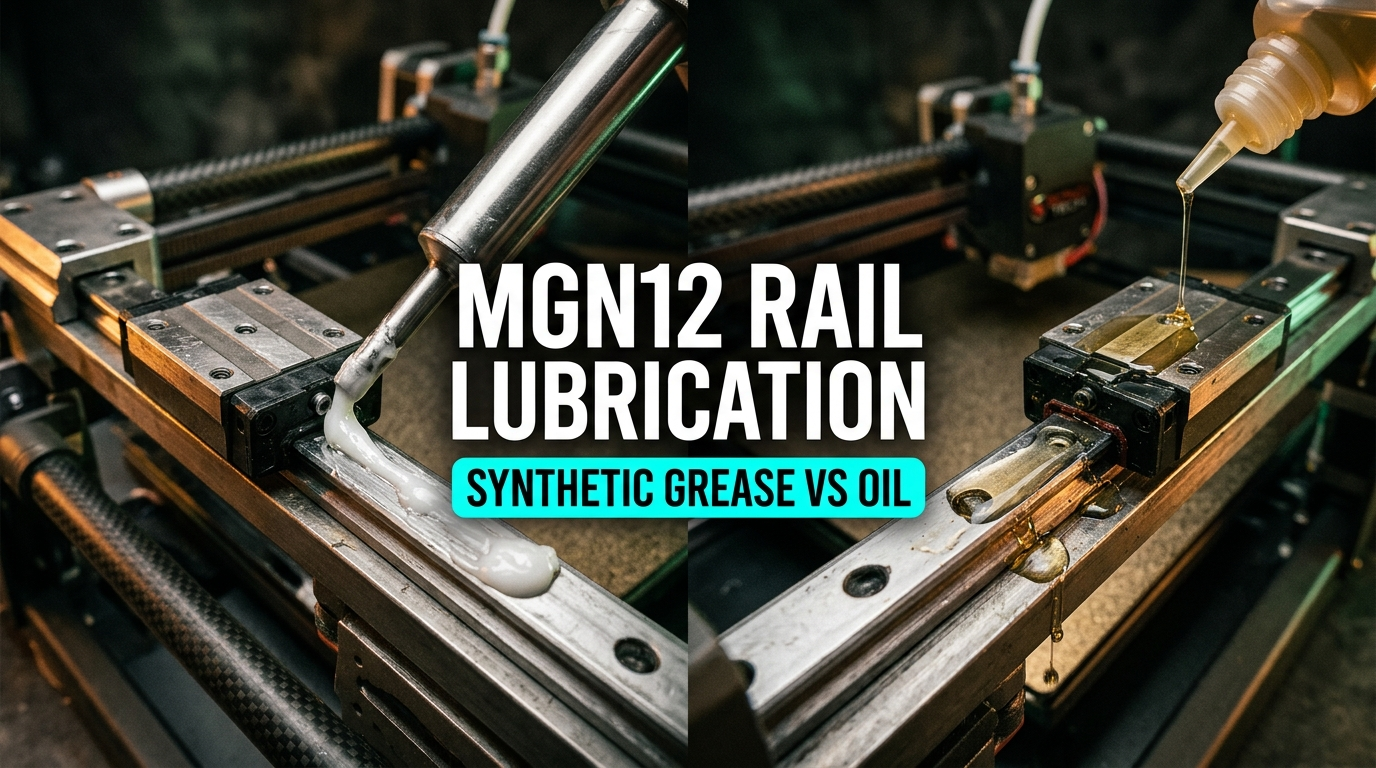
Pull a brand-new MGN12 linear rail out of its plastic sleeve, drop a few squirts of sewing machine oil into the carriage, and slide it back and forth by hand. It feels silky and nearly frictionless on the workbench—which is exactly why so many makers assume thin oil is ideal for a 3D printer gantry.
Once that rail goes onto a CoreXY or high-speed bed-slinger pushing 10,000 mm/s² acceleration, that bench feeling misleads you. Short rapid infill strokes, heated enclosure air, and constant directional reversals quickly push thin mineral oil off the hardened steel raceways, leaving tiny bearing balls clicking dry against unlubricated metal.
Selecting the right lubricant changes far more than maintenance intervals. Proper grease viscosity dampens mechanical chatter inside the bearing block, keeps rust out of ground Gothic-arch grooves, and prevents premature surface pitting that shows up as ghosting or rough perimeter ripples in finished prints.
Table of Contents
- The Boundary Lubrication Problem: Why Light Oils Fail on High-Acceleration Toolheads
- Viscosity & Consistency Grades: Why NLGI 1 and NLGI 2 Greases Protect MGN12 Carriages
- Grease Chemistry Breakdown: Lithium Complex, White Lithium, and the PTFE Additive Debate
- MGN12 Linear Rail Lubricant Comparison Matrix (NLGI 0 to NLGI 2 vs Light Oils)
- Flushing Sticky Factory Preservative Oil Before First Installation
- Step-by-Step Carriage Greasing Protocol: Syringe Port Packing vs In-Place Relubrication
- How Enclosed Chamber Temperatures (55°C–65°C) Affect Rail Lubricant Bleed and Dust Trapping
- Maker's Workshop Note: Testing Super Lube vs Mobilux EP1 on My CoreXY Gantries
- Frequently Asked Questions (FAQ)
- References & External Sources
The Boundary Lubrication Problem: Why Light Oils Fail on High-Acceleration Toolheads
Light machine oils fail quickly on modern FDM linear rails because short, rapid oscillatory strokes prevent steel balls from rebuilding a hydrodynamic oil wedge, while high toolhead accelerations sling low-viscosity oil straight past the end wipers.
To understand why thin oil drops off so fast, look at what happens inside an MGN12H carriage compared with a spinning electric motor bearing. A rotary spindle spins continuously in one direction at thousands of RPM, constantly sweeping oil forward ahead of each ball bearing. A 3D printer toolhead does the exact opposite. During gyroid infill or small perimeter details, the carriage darts back and forth over distances shorter than 15 mm—often less than the full recirculation circuit length of the bearing balls themselves.
Under that stop-and-go vibration, thin lubricants face three mechanical disadvantages:
- Zero Reservoir Retention: Light mineral oils (like 3-in-1 household oil or ISO VG 15–32 sewing machine oil) lack a thickening soap matrix to hold fluid inside the internal return tunnels of the carriage. Gravity pulls oil down out of vertical Z-axis blocks, and rapid lateral decelerations fling droplets out along the X-axis extrusion.
- Starved Boundary Contact: When a toolhead reverses at 8,000 to 20,000 mm/s², momentary squeeze-film pressure forces low-viscosity liquid out of the tiny four-point contact zones inside the rail groove. Without enough film thickness, hardened 52100 bearing balls rub directly against the rail track, generating microscopic fretting corrosion (often seen as reddish-brown dust around the wipers).
- Lack of Acoustic Damping: Cheap budget MGN12 rails shipped on entry-level upgrades often carry loose clearance (Z0 or even slight negative play) and rough ball-return plastic bridges. Thin oil lets those steel balls rattle loudly against one another during fast travel moves, feeding high-frequency vibration straight into the print head and exacerbating vertical fine artifacts (VFA) and ringing.
Linear guideway manufacturers such as HIWIN explicitly publish shorter service schedules when oil is used instead of grease, often cutting relubrication intervals in half or requiring continuous automated oil-drip manifolds—hardware no desktop printer carries. Without an active oil pump feeding fresh droplets every few hours, oil-lubricated FDM rails tend to run dry far sooner than makers expect.
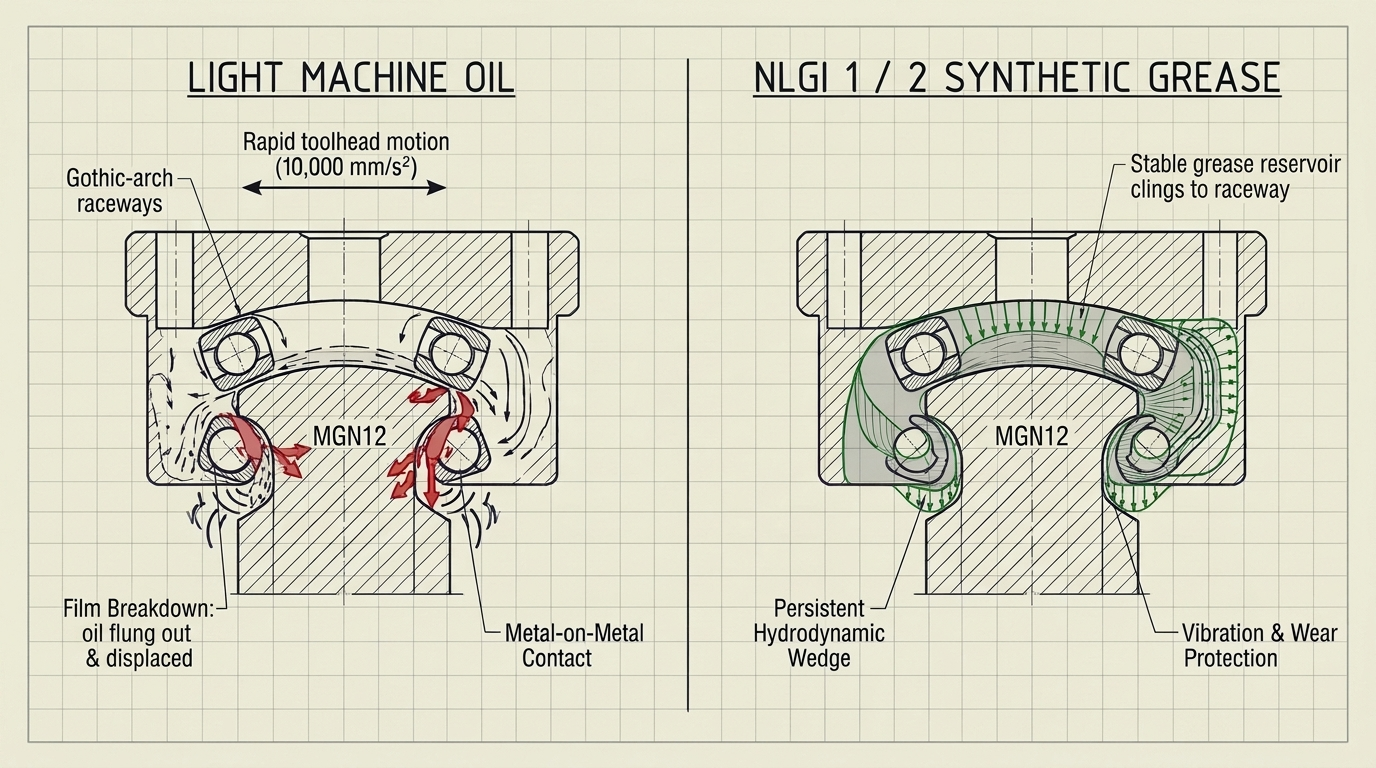
Figure 1: Thin machine oils get pushed out of high-load Gothic-arch contact points during rapid toolhead reversals (left), whereas properly packed NLGI 1 or NLGI 2 grease maintains a stable protective reservoir inside the ball return path (right).
Viscosity & Consistency Grades: Why NLGI 1 and NLGI 2 Greases Protect MGN12 Carriages
Grease rated at NLGI 1 or NLGI 2 works best on MGN12 rails because its semi-solid thickener sponge stays inside the carriage return channels while steadily bleeding base oil into the ball contact zones under load.
Many makers confuse grease "stiffness" with base oil viscosity, which leads to poor lubricant picks. Grease is essentially two parts working together: roughly 80–90% base oil that actually lubricates the steel, suspended inside 10–20% thickener (such as lithium complex soap, polyurea, or fumed silica) that acts like a microscopic sponge holding the oil in place.
The National Lubricating Grease Institute (NLGI) scale measures how stiff that sponge feels, ranging from fluid 000 grades up to brick-hard 6 grades:
- NLGI 0 and NLGI 1 (Soft to Semi-Fluid): Roughly the consistency of thick tomato paste or apple butter. NLGI 1 greases like Mobilux EP1 flow effortlessly through small 18-gauge syringe needles, distribute smoothly inside tight MGN9 and MGN12 ball paths, and keep rolling resistance low enough that delicate stepper motors won't lose steps on light-preload rails.
- NLGI 2 (Standard Bearing Consistency): Comparable to smooth peanut butter. Products like Super Lube 21030 and Mobilux EP2 hold tightly inside open-seal carriages, resist slumping out of warm printer chambers, and provide noticeable mechanical damping for slightly loose aftermarket rails. On small MGN7 or MGN9 carriages with heavy preload (Z1), however, overpacking NLGI 2 can create slight viscous drag on the first few homing cycles until excess grease clears the seals.
- NLGI 3 and Heavy Chassis Greases: Too stiff for tiny 1.5 mm to 2.38 mm balls inside miniature MGN rails. Thick grease tends to get pushed aside ("channeling") rather than slumping back into the ball path, causing balls to skid instead of roll cleanly.
Equally important is the base oil viscosity (measured in centistokes, cSt or mm²/s at 40°C). Documentation for community high-speed CoreXY printer designs typically recommends a synthetic or mineral base oil above 100 mm²/s at 40°C paired with Extreme Pressure (EP) additives. High-viscosity base oil resists squeezing flat at the pinpoint contact ellipse between a steel ball and its raceway, protecting the hardened rail finish across thousands of print hours.
Grease Chemistry Breakdown: Lithium Complex, White Lithium, and the PTFE Additive Debate
Choosing between lithium complex EP greases, synthetic PTFE-blended lubricants, and traditional white lithium comes down to oil separation resistance and seal compatibility rather than marketing additives.
Walk into an auto parts store or hardware aisle and you'll find dozens of tubes claiming universal bearing performance. On miniature 3D printer guideways, subtle differences in thickener chemistry separate reliable lubricants from ones that dry into chalky paste within six months:
- Lithium Complex & EP Mineral/Synthetic Greases (Mobilux EP1 / EP2, Kluber Microlube GL 261): Lithium complex soaps carry a high dropping point (often above 200°C) and exceptional shear stability. Extreme Pressure (EP) sulfur-phosphorus additives chemically bond to steel under microscopic high-pressure friction spikes. Even though a 3D printer toolhead feels light, the Hertzian contact stress on tiny 2 mm steel balls inside a preloaded MGN12H block is surprisingly intense. Dedicated linear-rail greases such as Kluber Microlube GL 261 (specified by Prusa for the XL and CORE One linear rails) and Mobilux EP1/EP2 resist oil bleed and hold up reliably in enclosed chambers.
- PAO Synthetic Greases with PTFE (Super Lube 21030): Super Lube relies on polyalphaolefin (PAO) synthetic base oil thickened with fumed silica and micronized PTFE powder. It's clean, translucent, safe for most rubber end wipers and ABS/ASA plastic carriage endcaps, and won't degrade polycarbonate or acrylic panels if tiny specks fling onto enclosure doors. One detail worth noting: in linear ball bearings, the PTFE particles aren't a cure-all—some industrial rail engineers point out that solid particles above 1–2 microns add minimal rolling benefit compared with proper EP chemistry, and excess solid fillers can slowly pack into tight Z1 preload tracks if over-applied. Used sparingly in clean MGN12H blocks, though, Super Lube 21030 performs reliably for hobbyist and semi-pro machines.
- Standard White Lithium Grease (Spray Cans & Cheap Tubes): Simple lithium-12-hydroxystearate white greases—especially aerosol spray cans loaded with petroleum solvents—often disappoint on 3D printers. Aerosol propellants flash off, leaving a thin carrier that rapidly separates ("oil bleed") into a puddle of clear liquid at the bottom of the enclosure and a crusty white soap cake inside the bearing block. Worse, aggressive aerosol solvents can swell or crack cheap nitrile wiper seals and attack printed ABS toolhead mounts nearby.
- Molybdenum Disulfide (Moly) & Graphite Greases: Black automotive CV-joint greases loaded with solid molybdenum or graphite particles belong on tractor axles, not miniature linear rails. Solid friction modifiers work well for sliding splines, yet inside small rolling ball bearings they can cause balls to slide rather than spin properly, accelerating wear and staining belts and build plates permanently black.
Workshop Gravity Test: Don't judge rail lubrication by whether the carriage slides down a tilted rail under its own weight. A dry, solvent-washed MGN12H carriage drops fast because nothing cushions the steel balls. A properly packed NLGI 1 or NLGI 2 carriage should feel smoothly damped with gentle finger resistance—never gritty, and never rattling freely down a 45-degree slope.
MGN12 Linear Rail Lubricant Comparison Matrix (NLGI 0 to NLGI 2 vs Light Oils)
Comparing popular workshop lubricants side by side shows why consistency, base viscosity, and chemical stability matter far more than how slick a fluid feels between your fingers. Use this benchmark matrix before packing your next rail:
| Lubricant Option | Base Chemistry & Grade | Operating Temp Range | High-Accel Film Retention | Acoustic Damping & VFA Impact | Workshop Verdict & Best Use |
|---|---|---|---|---|---|
| Mobilux EP1 / EP2 (or EP0) | Lithium hydroxystearate + mineral oil + EP additives (NLGI 1 / 2) | -20°C to +130°C | Excellent (resists fling up to 20k+ mm/s²) | High damping; quiets chatter on loose budget rails | Top mechanical pick for CoreXY MGN12/MGN9 rails and enclosed chambers. |
| Super Lube 21030 Synthetic Grease | PAO synthetic base + fumed silica + Syncolon/PTFE (NLGI 2) | -43°C to +232°C | Very Good (low bleed in warm enclosures) | Good acoustic cushion; smooth initial movement | Best clean multi-purpose option; safe on plastic endcaps and clean build areas. |
| Kluber Microlube GL 261 | Special lithium soap + mineral base + tribocorrosion EP (NLGI 1) | -30°C to +140°C | Outstanding (engineered for micro-oscillations) | Optimal balance of low drag and fretting protection | OEM gold standard for precision linear guideways (Prusa XL / industrial rails). |
| White Lithium Tube / Aerosol | Simple lithium soap + light solvent carrier (NLGI 1–2) | -15°C to +120°C | Poor to Fair (prone to oil bleed & soap caking) | Decent initially, degrades as soap dries out | Avoid aerosols near plastic parts; tube versions require frequent flushing. |
| Super Lube 51004 Synthetic Oil | PAO synthetic oil + suspended PTFE (~65 cSt) | -45°C to +232°C | Low (drains from return tracks under rapid infill) | Minimal damping; preserves ultra-light Z0 glide | Secondary option only for quick emergency touch-ups or smooth cylindrical rods. |
| Sewing Machine / 3-in-1 Oil | Light paraffinic mineral oil (ISO VG 15–32, no thickener) | 0°C to +90°C | Very Poor (slings off quickly at high acceleration) | Zero acoustic damping; amplifies ball rattle | Not recommended for MGN12 linear rails; leads to dry contact and rust spots. |
Workshop Sourcing Tip: CoreXY Hardware, Replacement Rails & High-Speed Filaments
Keeping your motion system quiet and tight pairs directly with reliable printers and consistent polymers. If you're upgrading an older bed-slinger with linear rails, replacing worn motion hardware, or stocking up on ABS, ASA, and high-flow PLA spools for fast CoreXY machines, take a look at our curated 3D Printing Deals & Coupons page for verified partner discounts across Elegoo, Creality, Anycubic, and Flashforge before paying full retail.
Flushing Sticky Factory Preservative Oil Before First Installation
Brand-new aftermarket MGN12 rails almost always arrive coated in sticky anti-corrosion shipping oil rather than working grease, so flushing that preservative residue with 90%+ isopropyl alcohol (IPA) before initial packing prevents mixed-lubricant gumming and metallic grit damage.
Wait—there's an important distinction here depending on what kind of printer or rail you bought. If you bought a factory-assembled machine from Prusa (like the XL or CORE One) or a pre-lubricated genuine HIWIN rail explicitly supplied ready to run, check the manufacturer's manual first. Prusa specifically warns never to spray IPA or harsh degreasers onto installed linear rails because solvents dry out wiper seals and wash out specialized factory grease.
On the other hand, if you ordered bare MGN12 rails for a Voron kit, an Ender linear rail conversion, or spare replacement rails from an online vendor, those parts normally ship dipped in thick, tacky rust-preventative oil. Leaving that shipping coating inside the block and mixing synthetic grease on top traps microscopic machining grit from the factory floor and weakens the grease thickener.
Follow this safe cleaning workflow for raw, uninstalled MGN12 rails:
- Never Slide the Carriage Completely Off Without a Rail Dummy: MGN12H carriages rely on tiny steel retention wires—or sometimes no retention wire at all on cheap clones—to hold loose bearing balls in place. Pulling the carriage straight off the steel rail usually dumps 40 to 50 tiny 2.38 mm steel balls across your workbench floor. Keep the block on the steel rail (or slide it directly onto a matching 3D-printed dummy rail segment) throughout cleaning.
- Pop Off Removable End Wipers (Optional for Deep Flushes): Many budget MGN12H blocks don't seal tightly anyway, while higher-grade blocks use rubber end seals held by two tiny M2 screws. If your carriage has screw-on endplates, check how snugly they seal; otherwise, leave them mounted and work fluid gently through the gap while avoiding soaking delicate rubber seals for hours.
- Soak and Agitate in 99% Isopropyl Alcohol: Submerge the rail and carriage in a shallow glass baking dish filled with clean 90–99% IPA for 10 to 15 minutes. Slide the carriage slowly from end to end while submerged so the solvent flushes yellowish preservative oil and stray steel burrs out of the ball return paths. If you prefer a non-plastic-safe industrial degreaser like mineral spirits, remove the plastic endcaps first so they don't craze or swell.
- Check for Sticky Spots and Dry Thoroughly: Pull the rail from the alcohol bath, wipe the exterior with lint-free shop towels, and let the carriage sit upright for at least 30 minutes until every drop of trapped IPA evaporates from the return channels. Applying fresh grease while residual alcohol remains inside the carriage turns the first layer of grease into thin slurry.
Once completely dry, move the carriage gently by hand to verify there's no grinding grit left inside. If it still catches or feels sandy at one spot, repeat the IPA rinse in clean alcohol before moving to the grease syringe.
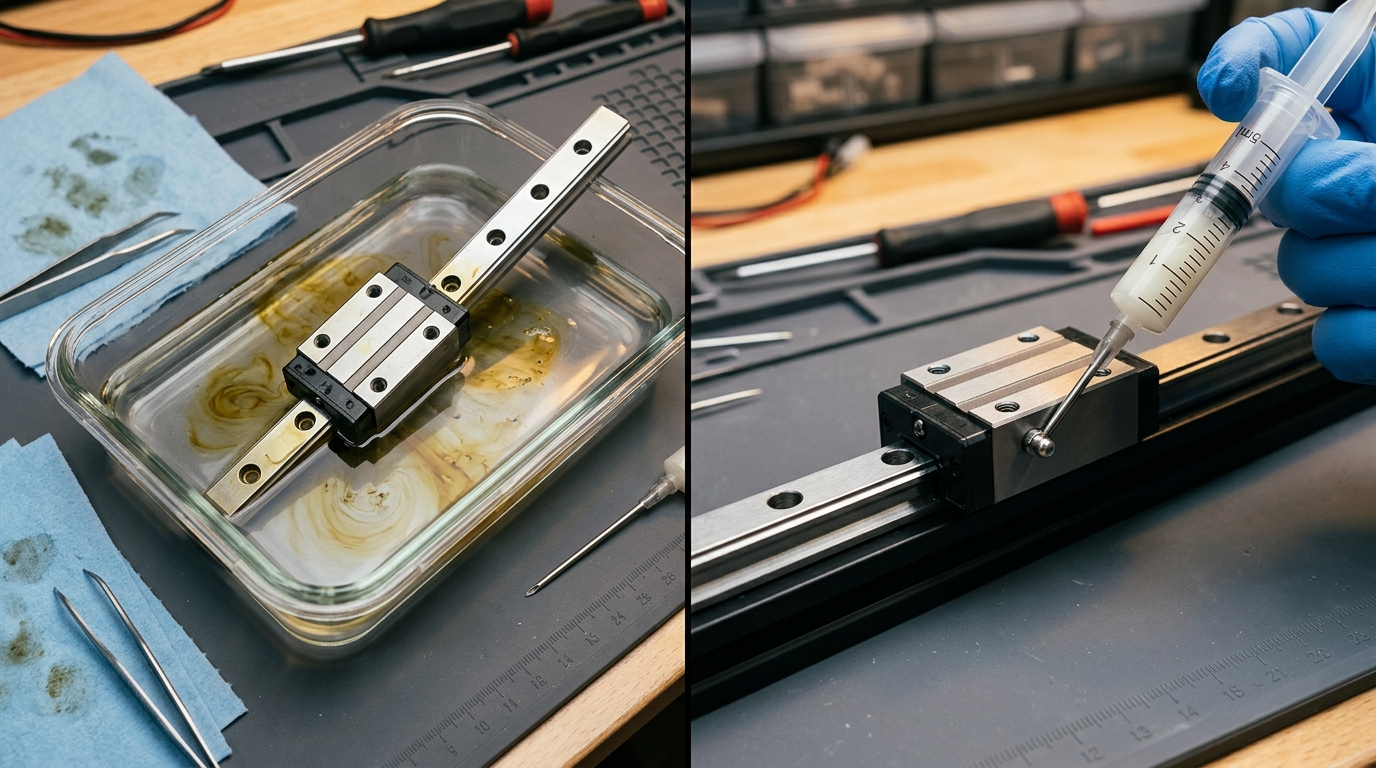
Figure 2: Flushing sticky factory preservative oil from raw replacement rails in an IPA bath before installation (left), followed by precision syringe packing of clean synthetic grease directly into the MGN12H carriage cavity (right).
Step-by-Step Carriage Greasing Protocol: Syringe Port Packing vs In-Place Relubrication
Packing a freshly cleaned MGN12H carriage through its top mounting holes or front lubrication port forces grease straight into the loaded ball paths, while ongoing in-place maintenance requires wiping the outer rail clean and injecting tiny doses directly beneath the end seals.
Smearing grease along the top surface of a mounted rail and sliding the carriage over it is the single most common lubrication mistake in 3D printing. Those rubber end wipers on an MGN12H block exist specifically to push contaminants off the steel track. When you smear thick grease onto the outside of the rail, the wiper blades act like tiny snowplows, scraping 90% of your fresh grease into messy piles at either end of the rail while almost nothing reaches the recirculating balls inside.
Use one of these two methods depending on whether the rail is loose on your bench or already bolted onto a printer extrusion:
Method A: The "Flip and Pack" Method (Best for New Unmounted Rails)
- Load a 5 ml Luer-Lock Syringe: Fill a small plastic syringe with Mobilux EP1, EP2, or Super Lube 21030 and fit a blunt 18-gauge or 20-gauge dispensing needle (usually 0.8 mm to 1.2 mm outer diameter). Avoid sharp medical needles that can bend or scratch internal plastic return bridges.
- Flip the Rail Upside Down: Hold the rail so the carriage mounting face points down or sideways, exposing the underside slot and endcap channels, or locate the small recessed grease port centered on the green/black endcap face.
- Locate the Endcap Grease Port or Ball Channel: On genuine HIWIN and quality LDO MGN12H blocks, a small molded oil hole sits on the plastic endcap just above the rail arch (sometimes plugged with a tiny M3 set screw or sealed behind a thin punch-out membrane). If your block uses an open bottom clearance slot along the underside groove, place the blunt needle tip right against the exposed ball return groove where the steel balls emerge.
- Inject Slowly While Cycling the Carriage: Press gently on the syringe plunger until a small pea-sized ribbon of fresh grease pushes inside, then slide the carriage slowly across 100 mm of rail length to draw the lubricant around the recirculation loop. Add one more small dose from the opposite endcap side until clean grease just begins to peek evenly around the wiper edges.
- Wipe the Exterior Rail Completely Dry: Use a clean, dry microfiber cloth to strip away every trace of excess grease on the outer rail faces, bolt counterbores, and wiper lips. Any grease remaining inside the carriage belongs there; grease sitting outside the seals just catches debris.
Method B: In-Place Relubrication (For Mounted CoreXY & Bed-Slinger Printers)
- Power Off and Cool Down: Cool the hotend and heated bed completely, home or position the gantry safely out of the way, and switch off the printer power supply so stepper back-EMF doesn't fight your movements or spike driver electronics.
- Dry-Wipe the Exposed Rail: Wipe both sides and the top face of the steel rail with a clean, dry lint-free tissue or microfiber cloth. Never spray solvent onto installed carriages.
- Use a Blunt Needle at the End Seal or Lube Port: Fit your blunt 20-gauge needle to the grease syringe. If your block has a front lube hole, inject roughly 0.1–0.2 ml (about the size of a grain of rice). If your block lacks an open port, carefully slip the smooth blunt needle tip barely 1–2 mm past the flexible lip of the end wiper alongside the rail groove—being careful not to pierce or tear the rubber lip—and dispense a tiny dab directly onto the inner ball groove.
- Exercise Full Travel 15–20 Times: Move the carriage slowly from end to end across the entire usable rail length 15 to 20 times so the balls roll smoothly through the new lubricant.
- Clean Away Pushed-Out Debris: Watch the wipers as you cycle the axis; old darkened grease mixed with microscopic dust will often purge out ahead of the seals. Wipe that dirty residue off with a fresh cloth before powering back up, then run a quick mechanical check or calibration test print to confirm smooth axis motion.
How Enclosed Chamber Temperatures (55°C–65°C) Affect Rail Lubricant Bleed and Dust Trapping
Enclosed chamber temperatures between 50°C and 65°C during ABS, ASA, or polycarbonate printing lower grease viscosity noticeably, accelerating base-oil bleed from lower-grade lubricants while increasing airborne plastic vapor condensation onto exposed steel rails.
An open-frame bed-slinger printing PLA in a 22°C room places very different demands on rail grease than an enclosed CoreXY printer soaked at 60°C for a five-hour engineering print. As ambient temperature rises from 22°C to 60°C, the kinematic viscosity of standard base oil drops sharply, and poorly formulated thickeners begin releasing free oil faster than the carriage needs it.
When printing high-temp materials inside an enclosure, watch out for three environmental interactions:
- Oil Separation & Drip Marks: Low-melting-point greases or over-greased carriages stored in a hot chamber tend to weep clear oil streaks down vertical Z-rails or drip onto the heated bed cable chain below. Synthetic PAO greases (like Super Lube 21030) and lithium complex EP greases (Mobilux EP1/EP2) hold their thickener structure stably well past 100°C without weeping excessively, provided you don't flood the block past capacity.
- Filament Dust, PTFE Shedding & ABS Vapor Haze: Every 3D printer sheds particulate debris over time: tiny PLA strings, carbon-fiber whisker dust from abrasive spools, worn rubber crumbs from belt edges, and condensed styrene haze from ABS/ASA prints. Exposed films of wet oil or sloppy external grease on top of the rail glue those abrasive fibers straight onto the track, turning a precision ground raceway into grinding compound. Keeping the exterior rail wiped dry solves 90% of this buildup.
- Seasonal Storage & Humidity Rust Spots: Even "stainless" MGN rails made from 440C martensitic steel can develop surface corrosion pits if left dry in a damp garage or basement workshop—especially after solvent flushing. A thin, virtually invisible sheen left behind as the carriage cycles across the rail protects the steel against humidity, while excess heavy globs should always be wiped away.
Maker's Workshop Note: Testing Super Lube vs Mobilux EP1 on My CoreXY Gantries
Maker's Workshop Note: What 1,200 Print Hours Taught Me About Rail Lubricants
In my workshop, I used to treat linear rails the same way I treated old brass Z-leadscrews or smooth cylindrical rods—wipe them down occasionally and add a couple of drops of thin synthetic oil whenever an axis started sounding harsh. Testing both approaches side by side across my CoreXY printers changed my maintenance routine completely.
Test 1: Light Oil Run-Out on a Custom CoreXY X-Axis (MGN12H, 12,000 mm/s² Accel):
On my primary CoreXY build running Klipper at 12,000 mm/s² acceleration and 300 mm/s travel moves, I cleaned a mid-grade stainless MGN12H rail thoroughly in 99% IPA and lubricated it exclusively with light synthetic oil (around 65 cSt viscosity). For the first week, the rail felt effortlessly light by hand and passed resonance calibration cleanly. After roughly 180 hours of printing Polymaker ASA and eSUN ABS+ inside a 55°C passive chamber (105°C bed), I noticed a sharp metallic buzz during short 4 mm gyroid infill strokes and faint diagonal ripple marks returning on flat walls. When I pulled the toolhead back and wiped the rail with a white shop towel, the grooves were completely bone-dry in the middle third of the travel span, while tiny oil rings had collected harmlessly at the extreme travel stops where the wipers rarely reached.
Test 2: Flushing and Packing With Mobilux EP1 vs Super Lube 21030:
To isolate the change, I flushed two matching MGN12H carriages from the same batch: I packed the Y-rails with Mobilux EP1 using a blunt 18-gauge syringe through the rear mounting port, and packed the X-carriage on a secondary test rig with Super Lube 21030 (NLGI 2) after removing the protective shipping oil. Both setups stayed dramatically quieter during fast diagonal travels compared with oil. After 600+ hours across mixed PLA and PETG runs—plus routine maintenance checks alongside my enclosed FDM troubleshooting and calibration logs—neither carriage had run dry, and wiping the exterior rails once a month pulled off barely a smudge of dark oxidized grease from the seal edges.
On my Creality K1C and enclosed CoreXY machines, I still keep a small dropper bottle of synthetic oil strictly for smooth guide rods or quick hinge squeaks, never for profiled MGN12 ball carriages. For an MGN12H block with normal Z0 or Z1 preload, Mobilux EP1 has become my default pick because it packs cleanly with a syringe without creating heavy drag on cold morning startups, while Super Lube 21030 remains a reliable backup when I want clean translucent grease near visible white enclosure panels.
Frequently Asked Questions (FAQ)
1. Can I use WD-40 to clean or lubricate my MGN12 linear rails?
No. Standard WD-40 Multi-Use spray is primarily a lightweight solvent and water displacer, not a bearing lubricant. Spraying it onto a rail strips away existing grease, leaves steel ball tracks virtually unprotected within hours, and softens plastic return bridges inside budget carriages. If you want to flush shipping oil from a brand-new unmounted rail, use 90%+ isopropyl alcohol, let it evaporate completely, and pack fresh NLGI 1 or 2 grease afterward.
2. Should I remove the MGN12H carriage block from the rail to grease it?
Only if you have a matching plastic or metal rail guide ("dummy rail") lined up flush against the steel rail end to catch the carriage. Budget MGN12 carriages often lack ball-retention wires, meaning pulling the block off into open air immediately drops dozens of tiny steel balls onto the floor. You can flush and pack a carriage completely safely while leaving it mounted on its steel rail.
3. How often should I relubricate MGN12 linear rails on an FDM printer?
With proper NLGI 1 or NLGI 2 grease packed cleanly inside the carriage, most desktop FDM printers only need light relubrication every 3 to 6 months—or roughly every 500 to 1,000 print hours (Prusa specifies ~100 km of axis travel or 3–6 months on linear rail models). However, wipe the exposed steel track dry with a clean microfiber cloth every few weeks to keep filament dust and belt particles from gathering against the wipers.
4. Why did my carriage suddenly feel stiff or sluggish right after greasing?
Overpacking an MGN12 carriage—especially with stiffer NLGI 2 grease on a tighter Z1-preload rail—fills every air gap inside the ball return path, adding temporary hydraulic resistance. Cycling the axis back and forth across its full travel 20 times usually pushes excess lubricant out around the wipers until rolling resistance settles down. If it remains tight, switch down to a softer NLGI 1 or NLGI 0 grease like Mobilux EP1 or EP0.
5. Can I mix Super Lube with factory grease already inside a rail?
Mixing unknown factory preservative oils or lithium greases with fumed-silica or polyurea greases can sometimes cause thickeners to separate or harden unpredictably. If the printer manufacturer supplied a documented rail grease (such as Kluber Microlube GL 261 on Prusa machines), stick with that exact grease for top-ups. When installing raw third-party MGN12 rails or switching grease chemistry completely, always flush the old oil/grease out with isopropyl alcohol first.
Related Guides & Next Steps
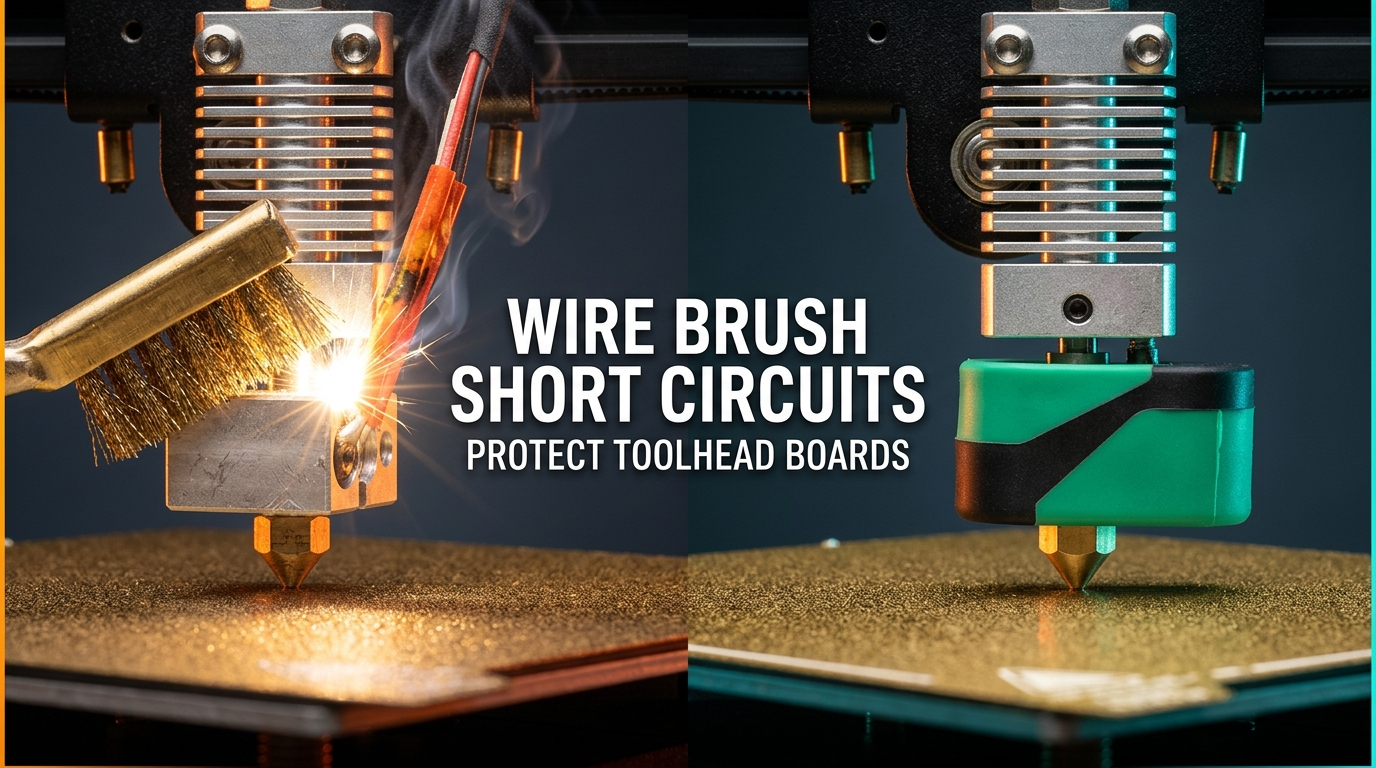
Wire Brush Short Circuits: Protect Toolhead Boards
Learn why scrubbing a powered FDM hotend with a brass wire brush shorts 24V heater lines into 3.3V thermistor ADC ports, and how to clean nozzles safely.

Common 3D Printing Failures & How to Fix Them
Struggling with corner warping, layer shifts, stringing, or bed adhesion? Discover practical troubleshooting tips to fix your prints.
References & External Sources
- Voron Design Official Documentation: Hardware Sourcing Guide & Linear Rail Grease Recommendations
- Voron Design Maintenance Guide: Linear Rail Cleaning, Relubrication Schedules & Motion Care
- Prusa Research Knowledge Base: Regular FDM Printer Motion System & Bearing Maintenance
- Bambu Lab Official Wiki: Basic Printer Maintenance, Guide Rails & Motion Lubrication
- Klipper Official Documentation: Input Shaping, Mechanical Resonance & Axis Diagnostics
About the Author: Dinu Suciu
I am Dinu Suciu, founder and prototyping specialist at 3D Print Book. Operating an active maker workshop equipped exclusively with desktop FDM 3D printers—including enclosed CoreXY builds and high-speed bed-slingers—I focus on linear motion reliability, mechanical tolerances, and repeatable print workflows for functional parts. Have a question about linear rail conversions or custom prototyping? Reach out directly through our Contact Page.